Home »
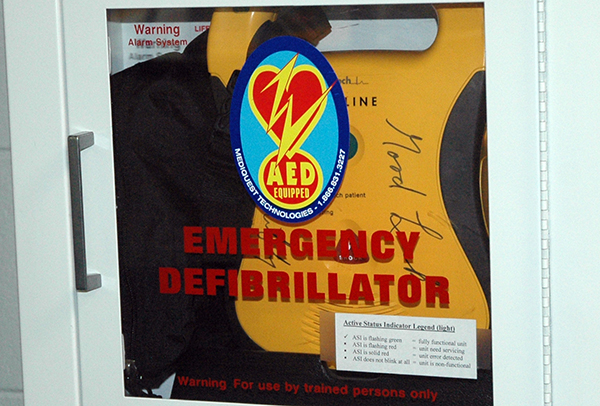
Register your AED, says Heart and Stroke Foundation
You’re out with a friend when she collapses in sudden cardiac arrest. You know you’re supposed to call 911, get an AED (automated defibrillator device) and start CPR. Seconds count.
Thanks to the newly established BC AED registry, the 911 dispatcher will be able to tell you where the nearest AED is located, whether it’s at the North Vancouver public library, Quality Foods on Vancouver Island or the Canal Flats Arena. Within those crucial few minutes, the AED is available to use on your friend, doubling her chance of survival.
In the East Kootenay, registered AEDs are located at: Canal Flats Arena; Edgewater Community Hall; District of Elkford municipal office; Max Turyk Community Centre and Fernie Aquatic Centre in Fernie; Kinsmen Beach in Invermere; Radium Community Hall in Radium Hot Springs.
There are no registered AEDs in Cranbrook, Kimberley or Sparwood.
However, in Cranbrook there are AEDs at such locations as City Hall, Western Financial Place, Memorial Arena, Cranbrook Public Library and the city public works centre. City corporate communications officer Chris Zettel informed e-KNOW the city will be registering the AEDs.
“The new registry is a vital step in helping people find the closest AED when there is a sudden cardiac arrest,” says Adrienne Bakker, CEO, Heart and Stroke Foundation, BC & Yukon. “Without defibrillation and CPR, the chance of survival decreases by seven to 10 per cent for each minute that passes.”
The Heart and Stroke Foundation strongly urges all those in possession of an AED to register their device so that all 911 dispatchers can notify those in an emergency situation where the nearest AED is located.
“This includes businesses, churches, schools, municipal buildings, individuals with an AED in their home – everyone,” says Heart and Stroke resuscitation manager Shelley Parker. Users of the registry have the option to make their information public or to allow only B.C. emergency services to see it.
“It may be that you’re at home and your spouse has a sudden cardiac arrest. The 911 dispatcher could tell you that there is an AED two doors down,” Parker explains. “Or maybe you’re bowling with friends at Canyon Lanes in Boston Bar when a team member suffers a cardiac arrest and a 911 dispatcher can tell you exactly where to find the AED at the bowling alley.”
It only takes a few minutes to register your device at: www.bcpadprogram.ca. Those few minutes can save a life.
Since 2013, the provincial government has invested $ 2 million in the BC Public Access to Defibrillators (PAD) Program, which will be matched by Heart and Stroke Foundation donors. The PAD Program is committed to install 750 community AEDs in public venues throughout B.C. by 2017.
In B.C., sudden cardiac arrest takes one life every four hours.
e-KNOW