Home »
Invasive of the Month
By East Kootenay Invasive Species Council
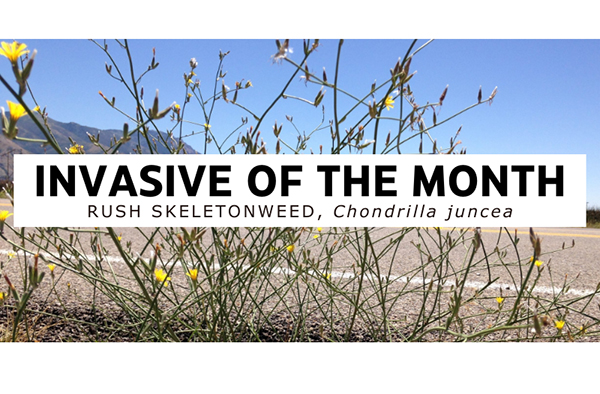
Rush Skeletonweed (Gum Succory, Devil’s Grass, Nakedweed) is a deep-rooted perennial plant that invades rangelands, roadsides, and other disturbed areas.
Native to Europe and Asia, it was unintentionally introduced to North America and is highly competitive, stealing soil moisture and nutrients from surrounding vegetation. A single plant can produce up to 20,000 seeds per year, which spread easily by wind and water and hitch rides on animals, people, and equipment like farm machinery. It also spreads underground through an extensive horizontal root system.
In British Columbia, Rush skeletonweed is listed as a Provincial Noxious Weed under the BC Weed Control Act and as a Provincial Containment species on the BC Provincial Priority Invasive Species List. In the East Kootenay, it is classified as a Regional Early Detection, Rapid Response (EDRR) species, as only a small number of sites are currently known.
Identification
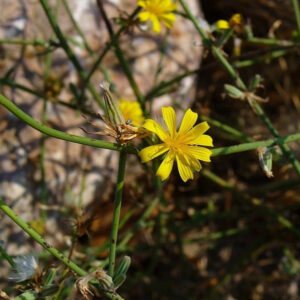 Flowers: Bright yellow, daisy-like flowers (one to two cm across) appear singly or in small clusters on nearly leafless stems.
Seeds: Fruits are achenes, three to four mm long, white to dark in colour, with a parachute-like pappus of white bristles that aids wind dispersal.
Leaves: Basal leaves are coarsely lobed with lobes pointing back toward the leaf base, covered in fine hairs and sharp spines along the margins. Stem leaves are few, narrow, and may have smooth edges.
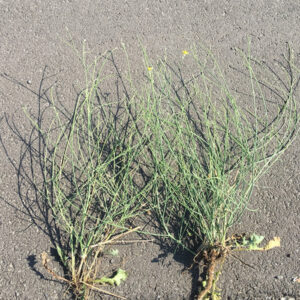
Stems: Rush-like in appearance, stems can grow up to 150 cm tall and are bright green to yellow-green, with many slender, leafless branches. Reddish, downward-pointing hairs are often visible near the base.
Sap & Roots: Both stems and leaves produce a milky sap when broken. Plants have a deep taproot (up to two metres) with lateral roots capable of producing new daughter rosettes.
Management
 Established Rush skeletonweed infestations require multiple years of management, with control focused on suppressing its extensive root system. Mechanical disturbance of mature plants often triggers regrowth, though young seedlings may be managed through cultivation. Frequent mowing can help exhaust root energy, but is rarely enough on its own.
Herbicide uptake is limited by the plant’s waxy surface, so adding an MSO surfactant improves effectiveness. Effective options for rosette or fall regrowth include Milestone, 2,4-D, Chaparral, Escort, Telar, Redeem R & P, and Tordon (restricted use). Herbicides should only be applied by someone with a valid BC Pesticide Applicator Certificate, following all label instructions and applicable regulations.
Maintaining healthy, competitive vegetation is a key long-term strategy, reducing open areas where Rush skeletonweed can establish.
 East Kootenay Invasive Species Council photos
The East Kootenay Invasive Species Council works to minimize the threat of invasive species that impact the environment, the economy and human health in the East Kootenay region of B.C., and we couldn’t do it without you! as a non-profit, we rely on grant funding and the generous support of our community to operate. Your donation will help us continue to protect the East Kootenay from invasive species. Donate here.