Home »
Invasive of the Month
By East Kootenay Invasive Species Council
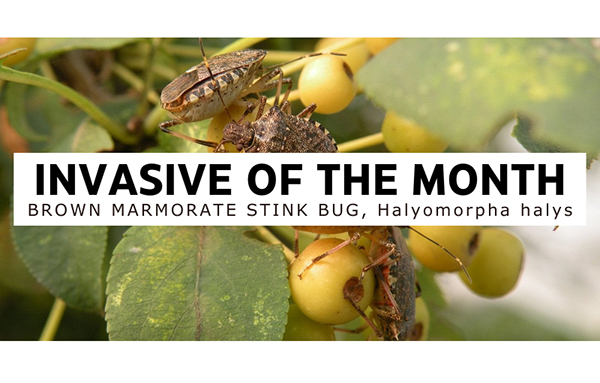
With our mild winter, we’ve had a few folks reach out about stink bugs appearing indoors – so here’s a quick rundown on the Brown marmorated stink bug (BMSB).
BMSB were first found in B.C. in 2016 and have been slowly spreading since. Native to Asia, they’re excellent hitchhikers and often travel long distances on vehicles and equipment.
Outdoors, BMSB can be a problem because they feed on a wide range of plants, including fruits, vegetables, and ornamentals. In other parts of North America, they’ve caused damage to crops like apples, grapes, peppers, and hazelnuts by piercing plant tissue and leaving behind bruised, blemished fruit.
Indoors, they’re mainly a nuisance pest. In fall and winter, BMSB look for warm places to overwinter and may gather in large numbers inside homes. That said, several native stink bug species look very similar, so proper identification is important before jumping to conclusions.
If you’re finding a few, the best approach is simple: remove them by hand or with a vacuum and seal up potential entry points. Insecticides inside the home aren’t recommended.
Identification
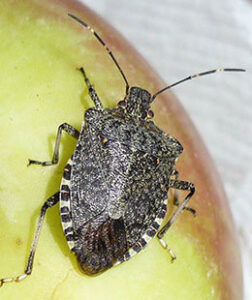
Adult: Shield-shaped, 13 – 17 mm long, brown marbled appearance, alternating brown and white markings on the outer edge of the abdomen; can be distinguished from other stink bugs by the presence of distinctive white bands on the last two antennal segments (see adult picture on left). Adults may be confused with other native brown stink bugs and western conifer seed bugs.
Egg: Spherical, white or pale green, 1.6 x 1.3 mm; laid in clusters of 20 – 30 eggs on the underside of leaves.
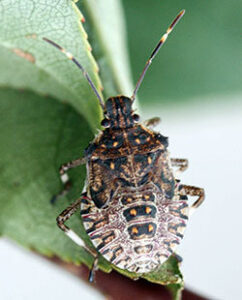
Immature (nymph): There are five immature stages. Nymphs range in size from 2.4 – 12 mm in length and do not have fully developed wings. Ist instar nymphs are bright orange to red in colour; second instar nymphs are black, tick-like; later instars are pear-shaped, brown with white markings on abdomen and legs and white bands on last two antennal segments.
Native Look-Alike Bugs (NOT Brown Marmorated Stink Bug):
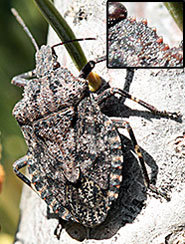
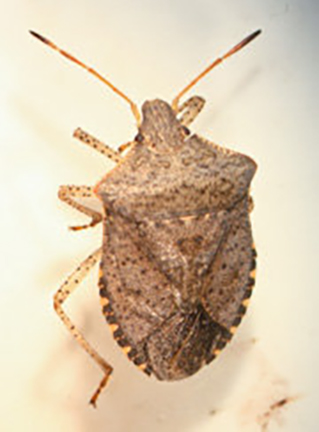
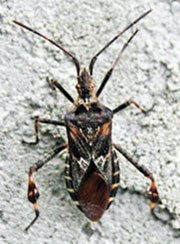
 East Kootenay Invasive Species Council photos
The East Kootenay Invasive Species Council works to minimize the threat of invasive species that impact the environment, the economy and human health in the East Kootenay region of B.C., and we couldn’t do it without you! as a non-profit, we rely on grant funding and the generous support of our community to operate. Your donation will help us continue to protect the East Kootenay from invasive species. Donate here.