Home »
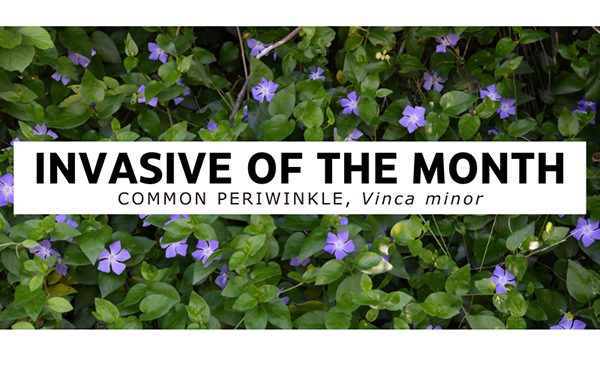
Invasive of the Month
By East Kootenay Invasive Species Council
Periwinkle was introduced to North America in the 1700’s, as an ornamental.
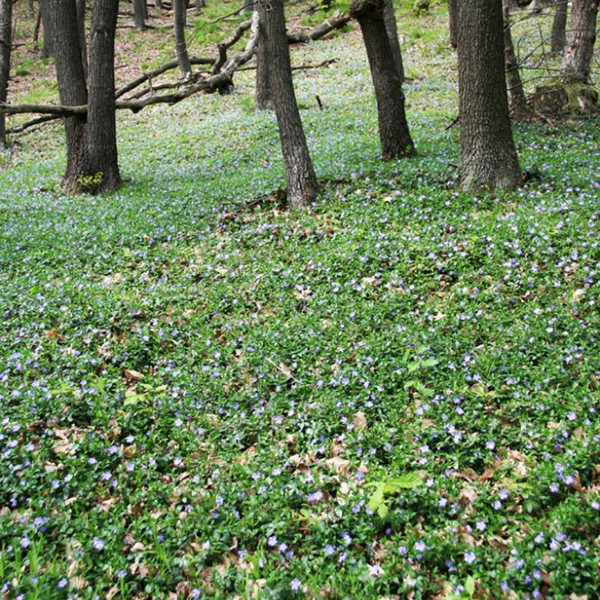
This perennial evergreen plant reproduces by stolons and stems rooting at nodes and can form a dense groundcover layer. These characteristics have made it a commonly sold bedding plant. These characteristics also make it an invasive species that can crowd out and discourage the growth of native plants in conifer forests.
IDENTIFICATION:
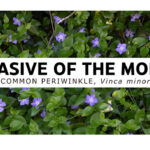
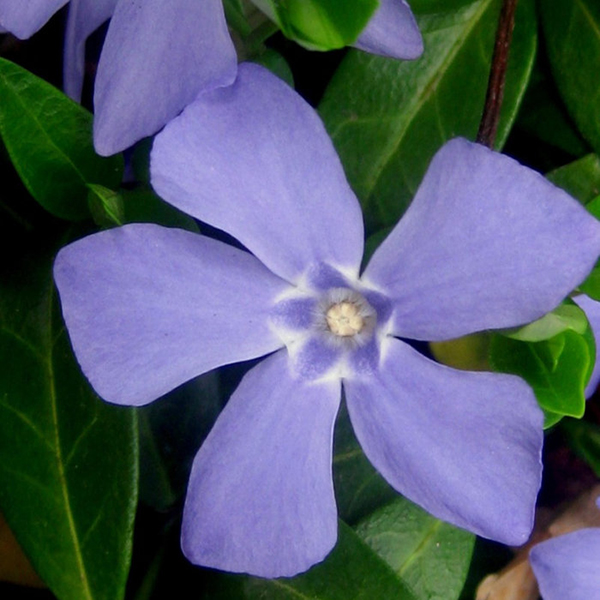 Flowers: This evergreen vine produces single blue-purple, sometimes white or violet pinwheel-like flowers, one per stem, late spring or early summer blooms are usually 20-30 mm wide, calyx lobes glabrous.
Stems: Evergreen slender stem, 10-60 cm long, branched out to form trailing and spreading groundcover.
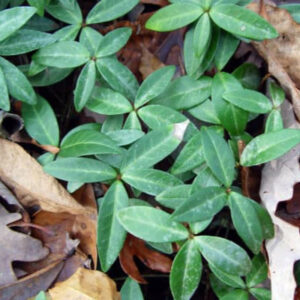
Leaves: Opposite, glossy, thick, dark green, egg or oval shaped leaves narrow at base, three to nine cm long.
Fruits: Three to five cm long, cylindrical pods.
IMPACT:
 Economic: Unpalatable to livestock.
Ecological: Common periwinkle is highly adaptable and forms dense mats even in shady areas causing it to squeeze out native vegetation in area.
 MANAGEMENT:
Mechanical control: Small infestations and seedlings can be pulled, “matting” for four to six months may also be useful for smaller infestations.
Chemical Control Herbicide recommendations and use must first consider site characteristics and be prescribed based on site goals and objectives. Herbicide labels and other sources of information must be reviewed before selecting and applying herbicides – Foliar glyphosate herbicide application in spring after mechanical methods will discourage regrowth.
 East Kootenay Invasive Species Council photos
The East Kootenay Invasive Species Council works to minimize the threat of invasive species that impact the environment, the economy and human health in the East Kootenay region of B.C., and we couldn’t do it without you! as a non-profit, we rely on grant funding and the generous support of our community to operate. Your donation will help us continue to protect the East Kootenay from invasive species. Donate here.