Home »
Investing in wetlands an investment in shared prosperity
 By Andrew Holland
Op-Ed Commentary
Canada’s wetlands are not scenery. They are working infrastructure, and one of the country’s most underused economic assets. As we mark World Wetlands Day, it’s worth asking why one of our most effective tools for managing risk, protecting communities and reducing public costs remains consistently undervalued.
Each year, many communities experience the impacts of intense rainfall and flash floods from city neighbourhoods to coastal regions. According to the Insurance Bureau of Canada insured damage from severe weather exceeded $2.4 billion last year alone, making it one of the costliest years on record. Those costs don’t vanish. They show up in higher insurance premiums, higher public spending and tougher choices for governments and households alike.
Canada has an advantage few countries possess. We are home to roughly a quarter of the world’s wetlands—an advantage few countries possess. Yet more than 200,000 square kilometres of Canada’s ponds, bogs, swamps, salt marshes, estuaries and other wetlands have been lost, largely due to pollution and land conversion. Near cities and towns, between 80 to 98% have already disappeared. In the places where Canadians live and build, most original wetlands are gone.
Flooding, drought, storm damage, water treatment are expensive line items for governments, businesses and taxpayers. Wetlands help keep those costs down. They naturally absorb storm surges, reduce flood severity, filter pollutants and recharge groundwater, quietly performing services that would otherwise require costly engineered solutions.
Every hectare restored reduces future disaster-related spending measurably and predictably. That’s not theory. It’s proven risk reduction that directly protects infrastructure, balance sheets and communities. Like well-designed public works, wetlands deliver returns for decades, with low operating costs and long service lives.
Wetlands also strengthen local economies. They support tourism and recreation, fisheries, higher property values and reliable water supplies for agriculture and industry. As climate volatility increases, they add another layer of protection by storing carbon, buffering extreme weather and stabilizing shorelines and riverbanks, helping lock in lower climate-related costs over time.
They do all this while providing irreplaceable habitat. Nearly half of Canada’s wildlife species, and a third of species at risk, depend on wetlands for at least part of their lifecycle.
This is not a hypothetical opportunity. Wetland restoration is practical, scalable and ready to deploy. Projects come with clear metrics, predictable timelines and strong community support. Across the country the Nature Conservancy of Canada has already helped secure the future of more than 930 wetland sites by working with Indigenous Nations, governments, landowners and local partners. Other conservation organizations are making a difference as well.
Put simply: investing in wetlands is smart asset management. It is risk mitigation. It is economic foresight. When we protect wetlands, we are not just protecting nature — we are protecting essential infrastructure, public finances and long-term prosperity.
As governments, businesses and insurers decide where to invest in resilience, wetlands should no longer be treated as optional or secondary. They deserve the same seriousness we give to roads, bridges and stormwater systems — because it is far cheaper to prevent damage than to keep paying for it after the fact.
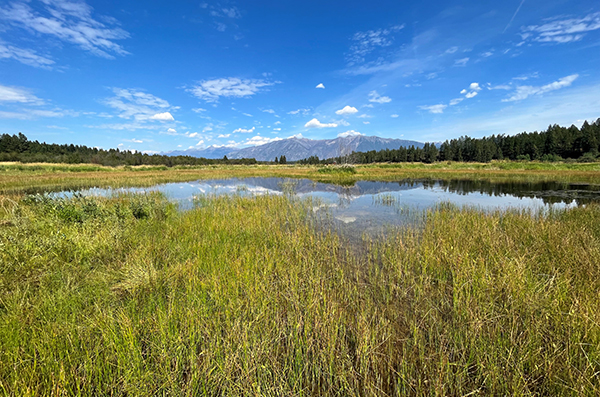
Lead image: Cherry Meadows. Photo by Richard Klafki
– Andrew Holland is director of external affairs with the Nature Conservancy of Canada.