Home »
Tilting at Windmills
By Peter Christensen
Op-Ed Commentary
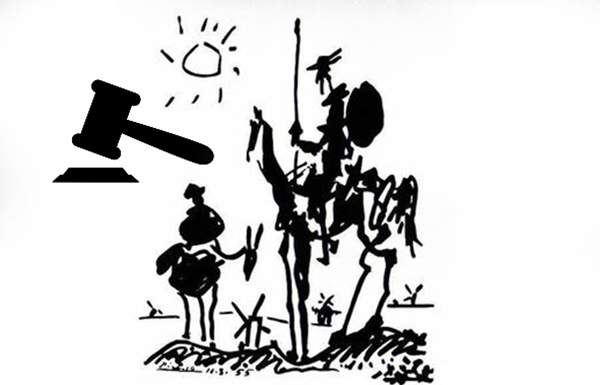
 Don Quixote, a story written in Spanish by Miguel de Cervantes, is considered to be Western Literature’s first novel.
Originally published in two parts in 1605 and 1615 it tells a story about a nobleman who has himself declared a knight by a barkeep and then sets off to set the world right. There are problems, the most famous of which is that while in his deluded state of mind, Don Quixote imagines that windmills are monsters.
Dressed in full armour and mounted on his trusty horse Rozinante, who is also awkward and past prime, Quixote challenges the windmills, becomes tangled in their blades, is thrown and defeated.
Don Quixote’s misadventures, like those of B.C.’s Premier David Eby who was caught in the blades of guilt, narrative and time, gave into the desire to overcome an impossible situation. Under Eby’s guidance as Attorney General, British Columbia passed the Declaration on the Rights of Indigenous Peoples Act (DRIPA).
It was widely understood by governments, businesses, and many Indigenous leaders as a ‘framework statute,’ a guideline to advance Reconciliation with Indigenous peoples. The Declaration was unanimously passed. Everyone believed that Reconciliation with Indigenous people was needed. British Columbians were assured that DRIPA would create no new rights, no vetoes, and no parallel legal order. It would guide how decisions were made, but not who governed.
Outside the legislature, Reconciliation work was well underway. Mining, forestry, energy, aquaculture, and infrastructure developers in co-operation with First Nations developed impact-benefit agreements, training programs, revenue-sharing models, and Indigenous-owned service companies. Economic reconciliation was imperfect, but it was happening.
Five years later, “when the B.C. Court of Appeal released its decision in Gitxaała v. British Columbia. The Court of Appeal, bound by Statute, confirmed that DRIPA is binding law and that it carries enforceable obligations. It held that B.C.’s mineral-claims regime is unlawful because tenure is granted without prior consultation—a finding with wide-reaching consequences that extend well beyond mining. This shift followed close on the heels of the Cowichan Tribes ruling, which legal experts warn could allow Aboriginal title to invalidate fee simple interests, in certain circumstances.”
The negative effect on investment confidence was immediate.
One of the clearest warnings came from BC Conservative MLA Á’a:líya Warbus, a member of the Stó:lō Nation, who argued that the province failed to appreciate the implications of its own legislation.
“This race to retrofit British Columbia’s long-standing democratic authority imposes waves of sweeping uncertainty,” she wrote, calling for repeal and replacement. “Economic reconciliation deserves integrity, certainty, honesty, and real partnership—not the overreach the NDP forced onto British Columbia.” Even Premier Eby has acknowledged the instability, conceding that the ruling “potentially puts courts in the driver’s seat.”
B.C.is now attempting to operate under two overlapping legal frameworks—one rooted in parliamentary democracy and British Common Law, (judge-made law) rather than comprehensive codes embedded in an international human rights instrument that was never designed to function as domestic land-use law.
As an interesting side note, one could point to the difference between British Common Law and Napoleonic Law, or French Law. While Common Law examines whether a proposal will be fair in its long-term implications, French Law writes a Statute and then examines whether or not an argument fits with the statue as written. The core failure of DRIPA is the absence of ongoing democratic process and consent.
Most British Columbians, including many conservatives, accept that Aboriginal title exists, that historic wrongs must be addressed, and that Indigenous nations deserve a meaningful role in decisions affecting their lands. The challenge is to create a warrant, a promise, that acknowledges Indigenous Rights, without inhibiting economic development.
The federal government embedded The United Nations Declaration on the Rights of Indigenous Peoples into Canadian law. (UN Declaration Act (UNDRIP Act) in 2021.) The Trudeau Government sought finality, a French Law solution. They wanted to be done with negotiation. However, for effective contracts to exist between ‘First Nations’ and Provincial ‘Nations’, between Municipalities and ‘First Nations’ a willingness to adapt on the part of all parties is needed. Rather than more complex argument in the courts over the intent of Statute.
There are outside interests that would like nothing better than to see Canadian sovereignty dissolve into a tangle of malfunction where the courts rather than Parliament become an instrument of suzerainty, the power to control a weaker or dependent state. Argument over the intent of a statute rather than bargaining in good faith discourages investment and enables separation sympathy leaving newly formed independent states vulnerable and eligible to join the United States.
Be careful what you wish for? B.C. has an opportunity to fix what it has broken by restoring democratic accountability and re-establishing a single, coherent legal framework under which we can share prosperity and retain autonomy.
– Peter Christensen is a Columbia Valley based writer and poet