Home »
Elk River on 2026 Most Endangered Rivers List
The Elk River is among the eight B.C. rivers on the Outdoor Recreation Council of BC’s (ORCBC) 2026 Most Endangered Rivers List.
Tying for top spot on the list are Vancouver Island’s Cowichan River and the Heart of the Fraser, a stretch of the Fraser River in the Lower Mainland between Mission and Hope.
The Elk River appears on the list because of concerns about coal mine expansion in its headwaters. But like most of the rivers on the list, the ORCBC sees positive progress in preserving river health.
“On the Elk we were happy to see work by the recreation community and Tourism Fernie to continue to improve recreational access and sustainable use of the river,” said Louise Pedersen, executive director of the ORCBC. “These developments really make a difference to river health.”
For more than 30 years, the ORCBC has released BC Endangered Rivers Lists to raise awareness about clean water and free-flowing rivers. The ORCBC is a provincial organization that advocates for recreation access to land and water on behalf of more than 100 non-profit clubs and associations representing more than 200,000 British Columbians.
By publishing the list the ORCBC is recognizing progress like this and seeking government action in 2026 to address lingering issues.
The concern on the Elk River focuses on large-scale coal mining in the watershed that leaches contaminants, particularly selenium, into an important river for tourism and recreation. The mining companies are expanding water treatment to remove contaminants and oversight has been improved.
However, the Elk remains on the list because the expansion plan for one of the mines remains on the books.
This year’s list also identifies several other ‘rivers of concern:’ the Kettle River in the Okanagan, the Stikine River in the North, the Similkameen in the Okanagan, and the crisis facing Thompson/Chilcotin river steelhead.
“The list is not meant to be all-inclusive, but rather to highlight key issues and encourage action,” said Mark Angelo, ORCBC’s Rivers Chair and founder of both BC and World Rivers Day.
Since the list’s inception in 1993, it has helped focus efforts to protect the Tatshenshini River from development and address mine pollution in Howe Sound’s Britannia Creek, among many other examples.
Preserving river health is also good for the provincial economy, said Pedersen. A recent government survey found outdoor recreation contributes more than $4.8-billion to provincial GDP every year. She would like to see more acknowledgement of that value by including the interests of outdoor recreation in river and water planning.
For example, the Cowichan River water planning process overlooked ways the weir project could benefit recreation, even though the river is important to the whitewater paddling community on Vancouver Island.
“In this massive project, there was a chance to add more recreational value and it fell through,” she said. “That’s all too common. Recreation is a major part of B.C.’s economy. Recreation needs to be nurtured just like any other industry.”
Pedersen is also concerned about the potential for unchecked industrial development to negatively impact rivers and recreation. In particular, federal and provincial legislation will expedite the environmental assessment process for some major projects, including mines that could impact water quality downstream, and pipelines and electricity transmission lines, which will cross many streams and rivers.
Pedersen and Angelo acknowledge the need to diversify B.C.’s economy, but are concerned governments don’t always recognize the downstream contributions of river conservation. Healthy rivers protect water supplies for communities and industry, generate the majority of the province’s energy, and support important recreation and food fisheries. They also reduce the impacts of flooding and droughts.
In considering this year’s Endangered Rivers List, Angelo says, he was left with mixed feelings. Like he’s wading across a fast-moving river: two steps forward, one step back.
“We are seeing glimmers of hope,” Angelo said. “Investments in river conservation have big payoffs. Nature can heal itself if we only give it a chance.”
B.C.’s Endangered Rivers List
- (tied) Cowichan River, Vancouver Island
Frequent low flows during the summer due to climate change are impacting fish survival and water quality.
The hope: There is a plan, along with a significant portion of funding, to raise the weir on Lake Cowichan to increase summer flows.
The concern: Final approval and construction could drag on.
1.(tied) Heart of the Fraser, Lower Mainland
Urban and industrial development continues to erode the ecological health of one of the most important salmon habitats on earth.
The hope: Conservation groups continue to purchase land for preservation.
The concern: There is no coordinated plan for conservation efforts, and development throughout much of the Heart of the Fraser continues.
Other rivers and issues of concern:
Elk River, Kootenay
Large-scale coal mining in the Elk River watershed leaches contaminants, particularly selenium, into an important river for tourism and recreation.
The hope: The mining companies are expanding water treatment to remove contaminants and oversight has been improved.
The concern: An expansion plan for one of the mines remains on the books.
Kettle River, Okanagan
Land use, water consumption and climate change impacts have caused low flows and water quality issues that impact human use and ecology in the watershed.
The hope: The Kettle River Watershed Management Plan has endorsed a comprehensive and collaborative water-use and stewardship plan.
The concern: The issues are complex and interconnected. A quick fix will be challenging to attain.
Stikine River, Northwest
Plans to fast-track the expansion of the Red Chris Mine could threaten the health of the Stikine, a world-renowned paddling river and one of the most important salmon-bearing streams in the northern half of the province.
The hope: Increasing calls by First Nations, paddling groups and conservation organizations, in both Canada and the U.S., should lead to stricter environmental protections and binding agreements between both countries.
The concern: The mine expansion plan includes the addition of a tailings pond, which brings higher risks of contaminants entering the watershed.
Similkameen River, Southern Interior
Indigenous communities and others are concerned the provincial government is rushing to approve an expansion plan at the Copper Mountain Mine south of Princeton.
The hope; The Upper and Lower Similkameen Indian Bands are asking the province for more time so that they can fully assess and gauge the risks of the project.
The concern: The proposed expansion would reopen an open pit mine that would extend close to the river and below the riverbed level, while the tailings dam would increase in size.
Thompson/Chilcotin rivers steelhead, Interior
More of a fisheries management failure than a river health issue, the perilous state of steelhead populations in the Thompson and Chilcotin rivers still requires urgent action. At one time thousands of these sea-run rainbow trout returned to these rivers to spawn. This year, only 19 steelhead are expected back to the Thompson River, and as few as 9 to the Chilcotin.
The hope: Sadly, there is little hope to be found on this issue. The federal and provincial governments have been unable to work together to find any resolution.
The concern: To date, there has also been an unwillingness to curtail indiscriminate, non-selective commercial fishing rather than focusing on more selective methods that allow non-target fish to be released alive and healthy. The result is the imminent extinction of the Interior population of steelhead stocks.
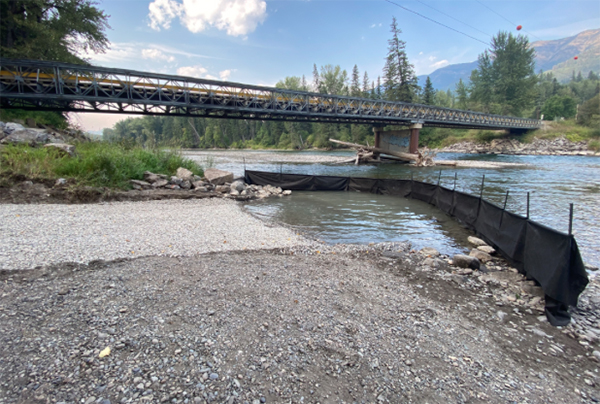
Lead image: Construction of the boat launch to the Elk River at Morrissey last year. Tourism Fernie image
e-KNOW