Home »
ICROL making welcome impact in Cranbrook
A partnership between Interior Health (IH) and the Cranbrook RCMP is demonstrating strong and valuable support for people who are experiencing mental health crises in the community.
Cranbrook is one of several IH locations that have an Integrated Crisis Response Outreach Liaison (ICROL), whose role is to respond alongside RCMP to people who are experiencing mental health and substance use (MHSU) issues and use de-escalation and harm reduction approaches to support these individuals.
Chelsey Weisbecker was hired for the Cranbrook role and has played a meaningful part in implementing the role in the community. She brings a mental health and substance use response directly into frontline crisis situations, reinforcing how impactful early intervention and human connection can be.
“My passion for trauma and crisis work began in the Emergency Department, where I saw firsthand how critical those first moments of intervention can be in shaping a person’s outcome,” said Weisbecker, Integrated Crisis Response Clinician – RCMP Liaison.
“This role as the integrated crisis response clinician has allowed me to take that work one step closer- to be present from the very beginning of a crisis, often in the immediate aftermath of trauma, mental health emergencies, or substance related crises, when people are at their most vulnerable. To be trusted in those moments, and to know that my presence may help create safety, hope, and a path forward, is a privilege I never take lightly.”
ICROL clinicians support RCMP in responding to mental health and substance use calls and have proven to be an important resource, both for local police detachments and teams throughout the Interior Health region.
This partnership has allowed MHSU services in the community to connect more effectively with RCMP and acute care.
“Chelsey has been an excellent addition to our service delivery model,” said Sgt. Stu Hert, Operations NCO for Cranbrook RCMP. “She has demonstrated the value of the program not only in crisis intervention, but also in her ability to connect clients with appropriate care or services to help avoid reaching the point of crisis.
“With a foot in both the health care and policing world, Chelsey is able to bridge the gap between the two and ensure effective transition from crisis response to on-going care. Seamlessly integrating with our team and establishing her credibility in the crucible of frontline police response, Chelsey exemplifies the values of compassion, respect and excellence in service that make up our guiding principles.”
The ICROL roles were implemented in February 2024 to enhance community crisis response in several communities in the health region including Nelson, Williams Lake, Trail, and Cranbrook.
“Through these clinicians, we are able to support clients and families more effectively while they try to navigate the health care system during some very challenging moments,” said Sean Airth, manager, clinical operations. “Because of the relationships Chelsey has developed within the RCMP, we have had the opportunity to identify individuals in need of support early on, allowing vulnerable people to connect with community resources that have improved their health and wellbeing.”
For more information about mental health and substance use services in IH visit interiorhealth.ca. To reach the Mental Health and Substance Use Centre closest to you and be connected to services, call 310-MHSU.
For information about the RCMP Southeast District visit the Royal Canadian Mounted Police webpage.
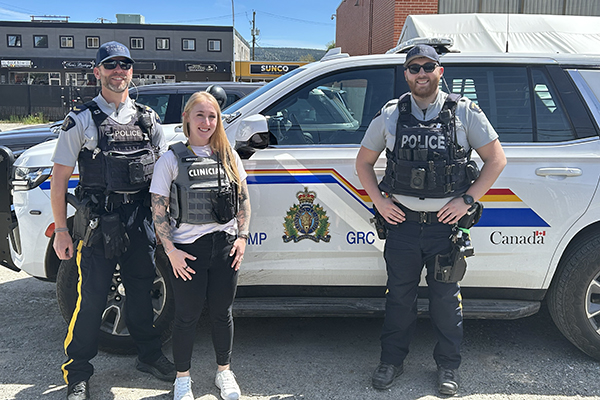
Lead image: (left to right, RCMP Watch Commander, Cpl. Corey Munro, Integrated Crisis Response Clinician – RCMP Liaison Chelsey Weisbecker, and Constable Matthew Hanna.) Interior Health photo
Interior Health