Home »
Invasive of the Month
By East Kootenay Invasive Species Council
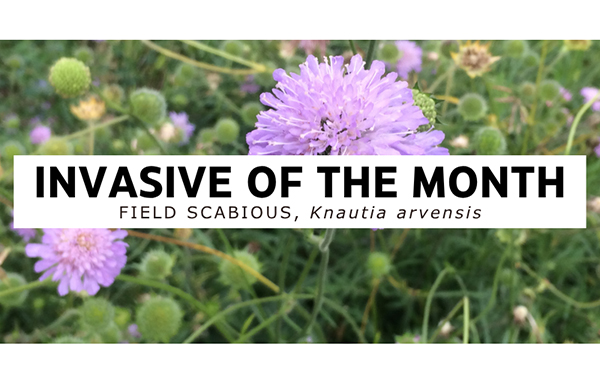
Field scabious crowds out forage and pasture plants, reducing food availability for grazing animals. It grows along disturbed roadsides throughout the province. It is an escaped ornamental popular for its pretty flower and ability to attract butterflies from its native range of Europe and Asia.
A single plant can produce up to 2,000 seeds, which makes this plant difficult to remove once established. Field scabious is designated as a Regional Noxious Weed by the BC Weed Control Act, as well as a Regional Containment/Control species by the BC Provincial Priority Invasive Species List. It is on EKISC’s priority list as currently known sites are limited to the Radium area.
 IDENTIFICATION:
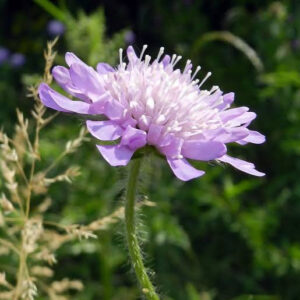
Flowers: Large, pincushion-like flowers grow singly on long, leafless stalks. Flowers are typically violet to pink, occasionally pale lilac, and bloom from summer into early fall.
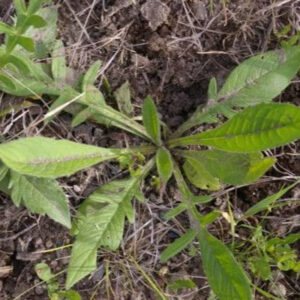
Leaves: Basal leaves form a rosette and are hairy, coarsely toothed, and variable in shape. Lower leaves are often oval, while upper leaves become more deeply divided and feather-like along the stem.
Stems: Upright, branched stems grow 30–100 cm tall and are covered in short hairs. Stems are slender and support individual flower heads above the surrounding vegetation.
Other: Field scabious is a perennial plant with a well-developed taproot. It spreads primarily by seed and is commonly found in grasslands, roadsides, and disturbed areas.
 IMPACT:
Agricultural: Field scabious reduces forage quality and pasture carrying capacity because it is generally unpalatable to livestock. It can also invade hayfields, allowing seeds to spread through contaminated hay and agricultural activities.
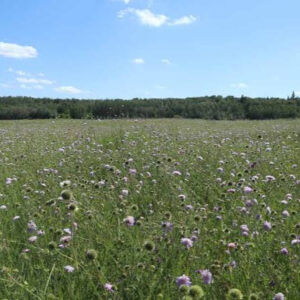
Ecological: Field scabious outcompetes native grasses and wildflowers, forming dense stands that reduce biodiversity and degrade wildlife habitat. Its long-lived seed bank makes infestations difficult to control once established.
Social/Recreational: The plant’s stiff hairs can cause skin irritation and rashes when handled. It commonly grows along roadsides, trails, and parks, where seeds can be spread by people, pets, and vehicles.
 MANAGEMENT:
Grazing: Field scabious is not palatable and seeds can be transported by animal movement. Invasive plants should never be considered as forage.
Cultivation: Discing before flowering is effective in crop land situations.
Mechanical: Mowing is effective to prevent seed production but would likely need to be repeated in the season because of re-sprouting. The deep tap root is difficult to remove in anything but loose soils; therefore hand pulling usually results in the stem breaking off at ground level and then resprouting occurs. However, any removal of seed is beneficial. Wear long sleeves and gloves as skin contact with the hairy plant causes considerable itching.

East Kootenay Invasive Species Council photos
The East Kootenay Invasive Species Council works to minimize the threat of invasive species that impact the environment, the economy and human health in the East Kootenay region of B.C., and we couldn’t do it without you! as a non-profit, we rely on grant funding and the generous support of our community to operate. Your donation will help us continue to protect the East Kootenay from invasive species. Donate here.