Home »
Watershed Study Board to release Draft Final Report
The International Elk-Kootenai/y Watershed Study Board will release its draft Final Report on September 30. This will mark the kick-off of a public comment period running until October 16.
All interested parties are invited to participate in virtual and in-person public meetings hosted by the Study Board during the public consultation period. The purpose of these events is to inform the public of the Study Board’s draft findings and recommendations and to gather feedback.
Dates and locations for these public events will be announced in the coming weeks.
How to provide input
All interested parties are encouraged to provide written input on the draft final report through the digital feedback form. They are also welcome to attend the upcoming public meetings to learn more about the Study and share their perspectives.
Currently, the Study Board is analysing the detailed findings of its four Technical Working Group reports on the following topics:
- Water Quality Status and Trends;
- Impacts to Human Health and Well-Being;
- Impacts to Ecosystem Health and Cumulative Effects;
- Mitigation.
The in-depth technical reports will be synthesized by the Study Board into its draft Final Report and recommendations.
Public input will be considered closely by the Study Board, which will publish a Final Report to be delivered to the IJC on December 9.
On March 8, 2024, the Governments of Canada and the United States provided a Reference that incorporates a proposal developed in partnership with the Ktunaxa Nation to the International Joint Commission (IJC), under the Boundary Waters Treaty of 1909, requesting the IJC undertake certain actions regarding the impact of transboundary water pollution in the Elk-Kootenai/y watershed.
One of the actions was to establish a study board comprised of experts and knowledge holders that would conduct and synthesize transparent and coordinated transboundary knowledge sharing and deliver a final report and recommendations to the IJC.
The Elk-Kootenai/y Reference, the Proposal, and the establishment of the Study Board are the result of many conversations and cooperative initiatives involving U.S. and Canadian federal governments, provincial, state and Indigenous governments, and stakeholders regarding the impacts of pollution in the watershed.
This is a historic moment for Canada-United States transboundary relations as it represents the first time that Indigenous Peoples have played a key role in the development of a reference to the IJC under the Boundary Waters Treaty of 1909.
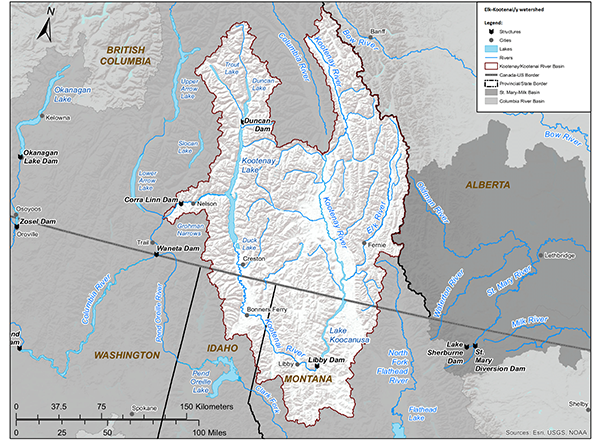 The Elk and Kootenai/y rivers rise in the Canadian Rockies of the province of British Columbia and flow into Koocanusa Reservoir, an impoundment of the Kootenai/y River that spans the Canadian-U.S. border. Below the reservoir, the Kootenai/y River continues to flow through transboundary Ktunaxa lands, through the states of Montana and Idaho, and back to the province of British Columbia where it empties into the Columbia River.
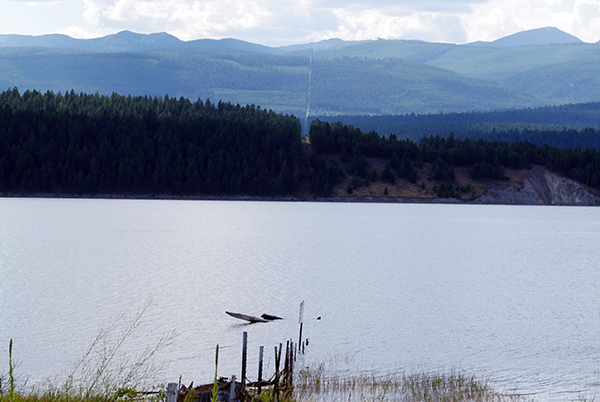
Lead image: The Canada/US border at Lake Koocanusa. e-KNOW file photo
Submitted