Home »
Political leaders rushing headlong toward a LNG cliff
Ottawa’s $200-million grant to Woodfibre raises an urgent question: who carries the risk if the export boom disappoints?
 By Bruce Murdoch
Op-Ed Commentary
Canada’s political leaders are treating LNG expansion as a nation-building opportunity. They should also be asking whether they are rushing headlong toward an economic cliff—and taking taxpayers with them.
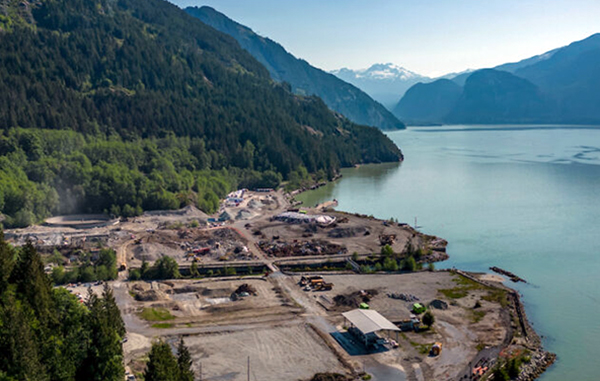
Ottawa’s newly announced $200-million conditional grant to Woodfibre LNG near Squamish brings that question into focus. The funding supports a proposed capacity increase at a project already under construction and backed by private investors. It is a grant, not a loan or a public ownership stake. According to Energy Minister Tim Hodgson, payments will depend on the company meeting benchmarks for investing in Canada.
Hodgson’s justification is environmental. Canada wants exceptionally low-carbon LNG production, he told Bloomberg, and asking investors to lead the world costs money. Woodfibre says it will achieve net-zero construction and operational emissions through hydroelectricity and carbon offsets. That commitment covers its own emissions and purchased electricity—not the eventual burning of the exported gas.
Lower production emissions may be worthwhile. But the public deserves to know what additional environmental benefit this grant purchases beyond commitments the company had already made. Investment benchmarks alone do not establish value for money.
There is a larger question, too: why are governments subsidizing additional LNG capacity as an enormous wave of competing supply approaches?
Even the optimists see fierce competition
The case for LNG expansion is not imaginary. Shell forecasts global demand rising approximately 65% by 2050. Importing countries want reliable energy, some face declining domestic gas production, and Canadian exports offer an alternative to vulnerable supply routes.
But growing demand does not guarantee profitable investment in every proposed terminal.
S&P Global’s new Canadian LNG study makes an optimistic case for expansion while describing a highly competitive market. Its release projects global supply increasing 50% over the next five years. It also identifies more than 600 million tonnes of annual project capacity at various stages of development competing for an estimated 176 million tonnes of market opportunity by 2050. Not all those proposals will be built—which is precisely the point.
Even Shell’s chief executive has questioned the investment rush. In September 2025, Wael Sawan expressed surprise at the number of projects proceeding at the higher end of the cost curve, describing the continued capacity additions as “not economically fully rational.”
That warning deserves at least as much political attention as Shell’s long-term demand headline.
Today’s shortage is not tomorrow’s business case
Current supply disruptions complicate the outlook. The International Energy Agency’s latest gas review finds that Middle East disruptions and infrastructure damage have delayed and reduced the market-easing effects of the LNG expansion wave. It would therefore be misleading to describe today’s market as already drowning in excess supply.
Yet a temporary shortage is a dangerous foundation for infrastructure expected to operate for decades. Facilities entering service later must compete against the supply available then—not the supply missing today.
The IEA’s Stated Policies Scenario identifies an LNG overhang in 2030. It says lower prices can attract additional buyers, particularly in price-sensitive Asian markets, but warns that prices needed to encourage further coal-to-gas switching could be difficult for exporters to match.
This is the central commercial problem. LNG demand may grow because prices fall. Those same lower prices can undermine the returns of expensive new facilities.
Woodfibre illustrates why costs matter. Argus now puts its implied terminal cost at approximately US$9.7 billion, based on Enbridge’s disclosed capital commitment and ownership share. That is an inferred figure rather than a consolidated budget published by Woodfibre, but it reinforces the need for a transparent assessment of competitiveness before public money is committed.
Energy security can mean buying less imported fuel
Political leaders frequently invoke energy security to justify Canadian LNG. They are only telling half the story.
Importing countries can improve security by diversifying foreign suppliers. They can also improve it by reducing their dependence on imported fuels altogether.
The IEA’s latest renewables outlook identifies energy-security concerns as a major driver of investment in domestic renewable electricity. China remains the largest contributor to global renewable-capacity growth, while deployment is strengthening across India and Southeast Asia.
Renewables, electrification and efficiency do not eliminate Asian LNG demand overnight. But they make it unsafe to assume that growing economies must purchase ever-increasing quantities of imported fossil fuels. In the IEA’s Stated Policies Scenario, clean-energy deployment and efficiency limit additional gas demand in China and Europe, leaving exporters seeking more price-sensitive customers elsewhere.
Our prospective customers are investing in ways to need less of what we intend to sell them.
GDP is not a return on public money
Governments understandably welcome construction jobs, investment and tax revenues. Industry studies supply impressive totals for each. S&P’s expanded Canadian development pathway, for example, projects substantial cumulative investment and GDP contributions through 2050.
But an economic-impact estimate is not proof that a subsidy is justified.
Construction can generate substantial economic activity even if a facility later earns disappointing returns. GDP is not government revenue. A cumulative benefit over decades is not money available to fund public services today. And an estimate of economic activity does not show whether the project would proceed without public assistance.
Economists reviewing Woodfibre’s commissioned economic study have questioned its treatment of benefits and its failure to account adequately for costs. Those criticisms should prompt independent scrutiny, not another round of headline-sized promises (CBC).
Publish the downside before writing the cheque
Premier Lorne Doerksen and federal ministers do not need to predict the precise date of an LNG glut. They do need to demonstrate that public support remains defensible if prices, costs and demand turn out less favourably than proponents expect.
For Woodfibre, that means publishing the grant conditions, the additional environmental outcomes being purchased, and any provisions for recovering funds if promised results are not delivered.
More broadly, governments should disclose independent assessments of project economics under sustained lower LNG prices, construction overruns and reduced utilization. They should account for public infrastructure, electricity-system costs and forgone revenues—not just advertise gross economic benefits.
Private investors may reasonably choose to take these risks. Taxpayers should not become the automatic backstop.
The LNG cliff is not a certainty. It is the possibility that governments commit public money during a period of exceptional prices and political enthusiasm, only to discover that the market awaiting these projects cannot support their costs.
Before rushing ahead, our leaders should show us the downside—and explain why the public should carry any of it.
Woodfibre LNG image
– Bruce Murdoch is a Cranbrook homebuilder and policy analyst. He was also recently elected to Cranbrook City Council.