Home »
Antares and a city of stars
By Dan Hicks
Op-Ed Commentary
Our summer stars offer some consolation for those of us who cooled on our public broadcaster for hyping Vancouver’s international soccer hijinks to the heavens – coverage amplified by “FIFA” -adorned Coke cans; but momentarily mitigated by New York’s fabulously divine Taylor and Travis matrimonial extravaganza –laudably divorced from taxpayer subsidies (but “¡Viva España!” anyway).
Heralded by occasional lightning flashes on Cranbrook’s southern horizon, our yellow Strawberry Moon – the first full moon of summer – emerged from the clouds for a while, after midnight of June 30; our remaining two summer moons are this July’s Buck Moon on the 28th and August’s Sturgeon Moon (27th) – our Buck Moon is well underway with Lunation #1281 having commenced with our new moon of July 14.
Planet Earth’s aphelion happened on July 6 when our planet’s almost perfectly circular life-friendly orbit around the sun swung out to its annual maximum distance from the sun – 8.46 light-minutes (152,087,774 km), 17 light-seconds – 3.4% further out than our January 3 perihelion when we came to within 8.18 light-minutes of the sun; accordingly, we are spared from a weird highly elliptical orbit which would inflict extreme temperature variations upon us, although our planet’s orbit is indeed an astronomical “ellipse” technically, it has an eccentricity of merely 0.0167 (“zero” constituting a perfect circle).
As our Cranbrookian latitude is 49.52 degrees, “true night” returned to us on the night of July 7 (July 7 -8) – (oriented to midnight) when – for 21 minutes, the sun’s center descended more than 18 degrees below our horizon for the first time since the night of June 3 (re astro twilight – the sun’s center is 12 to 18 degrees below our horizon).
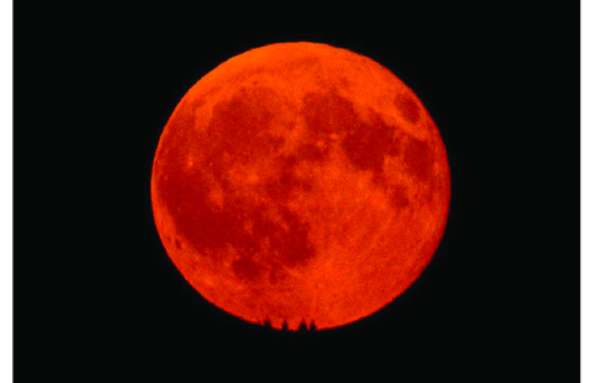
 Lead image: Corn Moon rising over Cranbrook Community Forest on September 7, 202. Dan Hicks photo