Home »
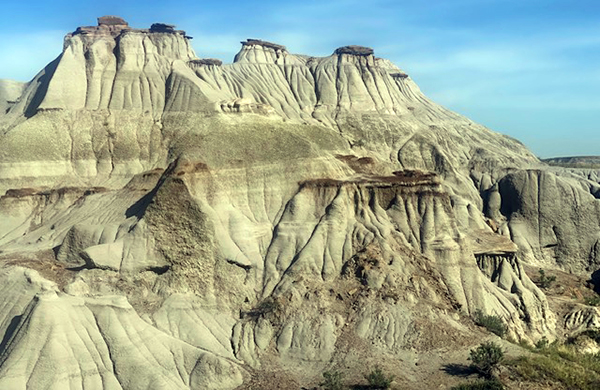
Dinosaur Provincial Park
By Peter Christensen
Op-Ed Commentary
 Destination: Dinosaur Provincial Park. We follow the Crowsnest Highway east through Brocket and Ft. McLeod, birthplace of Joni Mitchel, towards a grander Lethbridge than the small city of my university days, turn north at Lenzie west of the city to avoid the congestion of city traffic, make it past Iron Springs and Enchant, to Highway 36, a major north-south route in eastern Alberta that links the oil sands with Texas and Mexico.
The truck traffic is civilized and driving is less stressful than the extremely congested fast four lane Hwy 2 that links Edmonton and Calgary.
We turn east on 544 to Patricia, then onto Park Road 130, a good paved road that runs north, then east, then north before winding through flat, farmed landscape and across a desolate alkali prairie. It takes determination to stay on track. One feels dizzy rallying the changes of direction. Suddenly, the road drops off the eye straining plains into the Red Deer River valley, into the Badlands.
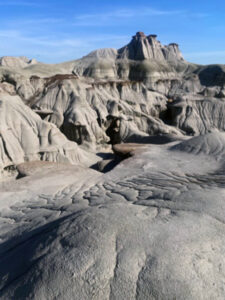 The view is stunning: paleontological hoodoos, cliffs, and valleys reach and cut in every direction. One of the richest fossil sites in the world scientists reconstruct prehistoric ecosystems to understand how organisms respond to environmental change. You feel the history!
Over 50 species of dinosaurs are catalogued; every ridge and ravine reveal fossils from the Cretaceous, a geological period that lasted from about 143.1 to 66 million years ago. It stresses the imagination!
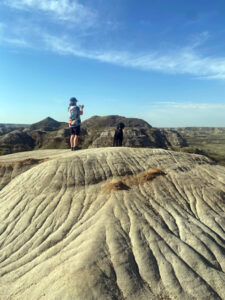
A compelling sense of wonder accompanies as one hikes the well laid out trails and routes accessible from the spacious campground. Ladders and stairs built to hug the bare clay walls lead into an ancient world. The convoluting shapes and cones reveal deep time.
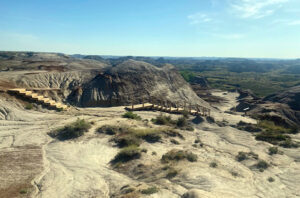 We are warned to be aware of rattlesnakes and black-widow spiders in the tall grasses. Near the end of our morning hike we encounter a small rattlesnake, politely isolated by traffic cones, coiled and soaking up heat from a warm concrete bridge that links parts of the campground. Park staff suddenly appear, ask us to be aware.
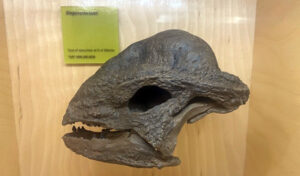
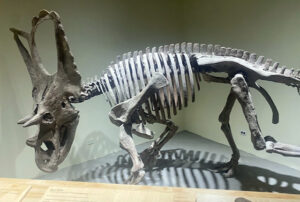
At the interpretive centre we review paleontological literature, study illustrations of the Crustaceous era and view reconstructed dinosaur skeletons. For 77 million years dinosaurs were top predators, then a massive asteroid collided with the earth and all but simple life forms were destroyed.
 Out of this new beginning we great apes came into being.
Two friends sit on the rear deck of a cruise ship in Tampa, Florida. The ship had come in from the sea to refuel and restock. From the sunny deck they watch hundreds of large speed boats racing from place to place, fighter jets thick as starlings swarm the sky, countless commercial airlines stack waiting to land, hundreds of commercial vessels at anchor wait to transfer cargo or to load.
Their conversation turns to environment, K said he had been studying climate change; listening to the dire consequences predicted. As an elected representative he had been asked to warn people of a coming environmental disaster and to tell them if they pay eight cents per litre carbon tax, they will save the planet. He sips his drink, looks around and points to the sky and says, “When all this comes to an end, I will tell people that an eight cent carbon tax will save the planet.”
 Yesterday we received a missive from the Red Sea, a friend aboard her well-heeled son’s yacht said they saved $40,000 US dollars by filling up in Turkey instead of Italy.
We should have stayed longer at Dinosaur Provincial Park to observe the evidence gathered from the primeval world that came to an abrupt end. Embedded, deep-rooted archaic human instincts and emotions are brought to the surface of our consciousness by being present here. It is an expanding experience.
 An event on the calendar determines our travel dates. After two days and nights in this ancient landscape surrounded by ancient land forms and a herd of 60-foot motor homes we enjoy the wonder of draining our grey water tank for the first time at an easy clean facility for such purposes then fill the fresh water tank with potable water before the steep haul up Park Road 130, to the great plains where we connect with the Veterans Memorial Highway, Hwy 36 north.
Photos by Peter Christensen
– Peter Christensen is a Columbia Valley based writer and poet.