Home »
Minister visits local flood-mitigation projects
B.C.’s Minister of Emergency Management and Climate Readiness visited flood-mitigation projects this week in Fernie, Invermere, Fairmont Hot Springs and Canal Flats.
“These timely investments in flood-risk reduction are critical to for the East Kootenay region, where people are now able to see the completed results,” said Kelly Greene, Minister of Emergency Management and Climate Readiness.

“This is tangible evidence of the progress being made throughout the province to address climate-caused hazards before disasters happen. These projects are only possible through our close partnerships with local communities.”
In Fernie, critical infrastructure is better protected from flooding with upgrades to the Mountview dike and the Coal Creek retaining wall where Coal Creek joins the Elk River.
More than 500 metres of the Mountview dike along the Elk River was raised to meet current standards and protect the Mountview neighbourhood. This project was funded with approximately $2.8 million from the Community Emergency Preparedness Fund (CEPF).
“The recent completion of the upgrades to the Mountview dike and Coal Creek bin wall marks another important step in strengthening Fernie’s flood resilience. This latest provincially funded project builds on a series of investments that each add vital protection for our residents, businesses and essential infrastructure. We’re grateful for the Province’s continued support as we work together to safeguard our community from growing climate-related risks,” stated City of Fernie Mayor Nic Milligan.
In Invermere, the province provided more than $1.9 million toward improvements to the Toby Creek dike. The Athalmer neighborhood of Invermere is a low-lying area immediately adjacent to Toby Creek at the confluence with the Columbia River. When flooding or ice jams occur in the creek, water or ice may cause damage in the neighbourhood.
This $3-million project raised the dike elevations along Toby Creek to withstand one-in-200-year flows.

“The safety and well-being of our community and citizens is our top priority. Raising the Toby Creek dike to a one-in-200-year safety measure makes our community much more resilient to the threat of flooding,” said District of Invermere Mayor Al Miller.
“We are pleased we’re supported with this funding from the Ministry of Emergency Management and Climate Readiness to enable this important work along Toby Creek to be completed, making a great spot for families and pets, even better.”
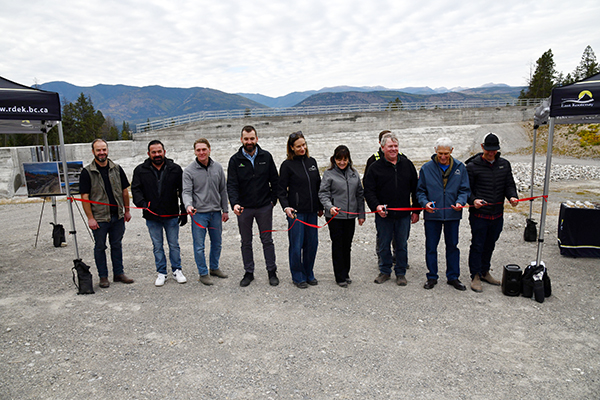
In Fairmont Hot Springs, the community’s debris-flow risk from Cold Spring Creek has been greatly reduced with the construction of a structure to capture and safely manage material from major storm events. A key feature is a debris-flow barrier designed to contain as much as 84,000 cubic metres of debris – approximately a 300-to-1,000-year return period event.
The barrier is about eight metres tall and 135 metres long, with an outlet fitted with steel bars to trap debris while allowing water to pass. This project was led by the Regional District of East Kootenay. The province contributed nearly $5.2 million toward the total project cost of $13.6 million. Learn more.
“Completing the Cold Spring Creek debris-flow mitigation project has not only made the community safer now but also enhanced its long-term resilience,” noted Susan Clovechok, Regional District of East Kootenay Electoral Area F Director.
“This achievement was possible thanks to both provincial and federal funding, as well as the support of the regional district board. These funding sources and the collaboration behind them enabled us to use scientific evidence to invest in infrastructure that safeguards Fairmont Hot Springs residents for decades to come.”
In Canal Flats, the village upgraded the existing flood-protection dike to meet updated flood construction levels with future climate considerations in mind. The previous dike structure protected the community to the approximately one-in-20-year flood level.
The upgraded structure provides protection up to the one-in-200-year flood level and protects critical community infrastructure. The project was funded with more than $618,000 from the province.
“The Village of Canal Flats is grateful to the Ministry of Emergency Management and Climate Readiness for supporting the upgrades to the Kootenay River dike. These improvements significantly enhance our community’s protection from high-water events and support a safer, more resilient future for the people of Canal Flats, as we face increasingly unpredictable climate-related weather,” said Village of Canal Flats Mayor Mark Doherty.
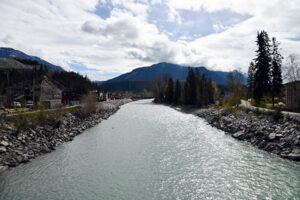 In Golden, the province provided more than $1.2 million from the CEPF for dike improvements along the Kicking Horse River. The project raises dikes along the Kicking Horse River to as much as one metre above the one-in-200-year flood elevation.
Ice jams during the winter and high water during the summer have threatened flooding in Golden over the past several years. The project includes rock armouring, dike face reshaping, vegetation removal and restoration, and fish habitat restoration.
“As Golden’s top public-safety project, completing the Kicking Horse River dike project marked a major milestone for our community. It significantly increases our level of flood protection now and well into the future, helping safeguard homes, businesses and critical infrastructure. The project also provided the opportunity to transform our riverfront, creating a vibrant public space where residents come to work, play and connect, and visitors can enjoy all that Golden has to offer,” stated Ron Oszust, mayor of Golden.
“When a community is hit by a flood, the effects are felt not just locally, but across B.C. Thanks to these investments, people, homes and businesses in the East Kootenay have stronger protection from flood risks than ever before. Alongside local partners, we’re celebrating these projects, which are a big step toward making sure people and communities are safe when the water rises,” said Randene Neill, Minister of Water, Land and Resource Stewardship.
More local projects are in the hopper.
Scheduled for completion in 2028, a new Gold Creek dam in Cranbrook will be built to a higher elevation than the existing dam, doubling the available water for the city to meet future water demands. It will also include allowances for fish passage, create a healthier aquatic ecosystem and avoid the need to remove sediment that accumulates upstream of the existing dam.
The project received more than $5 million from the CEPF.

“On behalf of the City of Cranbrook and city council, I want to thank the province for its generous support of this vital project,” said City of Cranbrook Mayor Wayne Price. “This project represents a significant milestone as it secures our community’s water supply for generations. Ensuring a reliable and resilient water system will empower Cranbrook to continue its growth and development while preparing for challenges posed by climate change.”
A second project in Invermere to upgrade the Paddy Ryan Middle dam will break ground in spring 2026. The project will raise the height of the dam and improve spillway capacity. The province provided $2.4 million from the CEPF for this project that is expected to be completed in 2027.
Since 2017, the province has provided more than $550 million for more than 2,800 disaster preparedness and mitigation projects administered through the Ministry of Emergency Management and Climate Readiness.
It includes approximately $340 million provided to First Nations and local governments for about 2,600 projects through the CEPF.
The province also established the Disaster Resilience and Innovation Funding program to help First Nations and local governments strengthen defences against natural and climate-caused hazards. To date, about $27 million has been committed for ongoing projects throughout B.C.
Lead image: The RDEK and project participants celebrated the completion of the Cold Spring Creek debris-flow mitigation project on Oct. 15, 2025. e-KNOW file photo
e-KNOW