Home »
The Power of Imaginary Realities
By Peter Christensen
Op-Ed Commentary
 In 1928 Olof Hansson, ‘Swedish vice-president’ to British Columbia, submitted a request to the Canadian Department of Indian Affairs to acquire a totem pole. Poles and other aboriginal artifacts were much in demand by European museums. In ‘29 Hansson was granted permission to negotiate and receive a pole that stood near the estuary of the Kitlope River, at the end of the Gardener Canal, 120 km east of Kitamaat.
One story goes that after negotiations with a native group at Kitamaat, a Norwegian emigrant named Iver Fougner (1870—1947) employed as an Indian agent cut down the G’psgolox pole and delivered it to Hansson who had it shipped to Sweden. It was donated to the Swedish National Museum of Ethnography. The museum kept the pole in storage for 50 years until they had a proper building finished to house it and in 1980 it went on display.
The reason the pole was known as the G’kpsgolox pole is because a Haisla Chief by that name, who had lost his family and friends to disease, commissioned the pole carved in 1872 and when finished placed at a village site near the Kitlope estuary to commemorate the death of G’kpsglox’s family and friends. A mortuary pole.
The Kitlope Valley was Henaksaila (sp)territory, a distinct people with their own language however all but a few of Henaksaila heritage died during the time epidemics raged the coast. The Henaksaila amalgamated with the Gitamaat Band near Kitimat in 1948 to form the Haisla native band, later known as a First Nation.
Rumors circulated about the pole’s location for years and in 1994 two representatives from the Haisla community of Kitamaat visited the Swedish National Museum of Ethnography in Stockholm where they identified it and over 10 years negotiated the return of the pole.
Many opinions and emotions tied to the pole are witnessed by an NFB film, The Return of the G’psgolox Pole.Source: National Film Board of Canada
Imaginary realities like those represented by the pole exert force on the world that replace complex realities in public memory; these parables strengthen desire for transition.
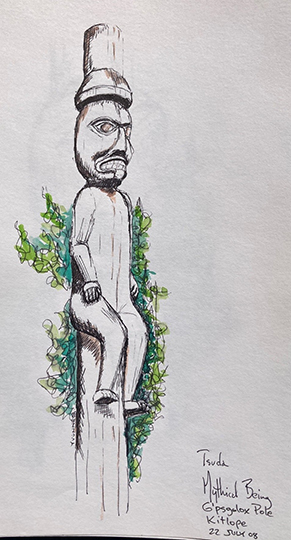 An agreement was made that two replicas would be carved. In 2000 the Henaksiala/Haisla carvers completed the task. One replica was given to the Museum and finished at the museum in Stockholm, Sweden. In 2006 the other replica was placed near where the original G’psgolox Pole had stood, at a village site beside the Kitlope River.
The original pole was shipped to British Columbia after a 134-year journey and stored in an empty store space at the Kitamaat Mall. Though there was disagreement about where the pole should be stored and its use, however, in 2012 the original G’kpsgolox pole was returned to the Kitlope and laid in the forest to disintegrate in accord with Haisla tradition.
My reason for writing about the return of the G’kpsgolox pole is to recount that a lengthy but diplomatic course was successful in the return of the pole though a costly and emotional undertaking.
I also have a personal connection to this story, while working as a Park Ranger in the Skeena Region I assisted in facilitating events, one of which was to arrange transportation and food for those wishing to attend the dedication ceremony for the replica G’kpsgolox pole now set near its original location at the Kitlope Heritage Conservancy or Huchsduwachsdu Nuyem Jees, 120 kilometres east of Kitamaat. A couple of large seiners based at Kitamaat were made available to transport people and I organized an easy to cook campfire dinner for attendees.
The Provincial Minister of Environment and Minister Responsible for Water Stewardship and Sustainable Communities arrived at Terrace Airport with a couple of tall, high heeled, tight-skirted assistants, one on each arm. They were flown by helicopter to the very remote Kitlope, where the Minister made a short speech, then in mythical semblance disappeared into the sky with his lanky team.
Currently, Canadian Indigenous communities identify as First Nations. Their historic 1981 Declaration of First Nations asserted Aboriginal sovereignty and self-governance. I hope this declaration will lead to undertaking responsibility for all of Canada’s citizens, to leadership in the defence of humane values. Currently, court room fires turn leaders into heroes, make a few rich while leaving many in poverty.
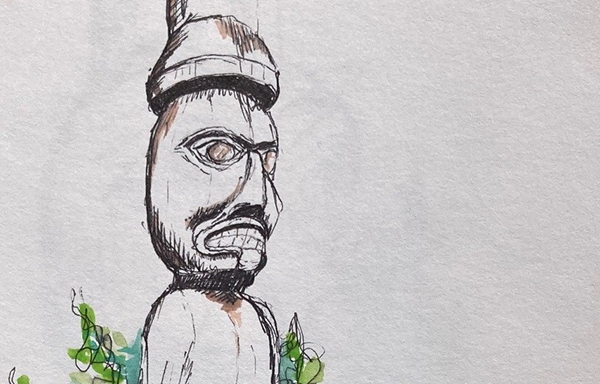
Image: A sketch made on location by Yvonne Christensen at the Kitlope River in 2006.
– Peter Christensen is a Columbia Valley based writer and poet.