Home »
Strengthening local food production in the Basin
 Solar energy and new crop trials support affordable, reliable food supplies
Primary food producers in the Basin will be tapping into solar power and testing new food crops as part of Columbia Basin Trust’s Farm Solar and Resilient Food Crops granting programs.
“People in the Basin rely on local farms, growers and producers for healthy, nutritious food,” said Justine Cohen, Senior Manager, Special Initiatives with Columbia Basin Trust. “By helping farms, ranches and other local food producers remain affordable, these projects will help keep local communities nourished and Basin food production innovative and thriving.”
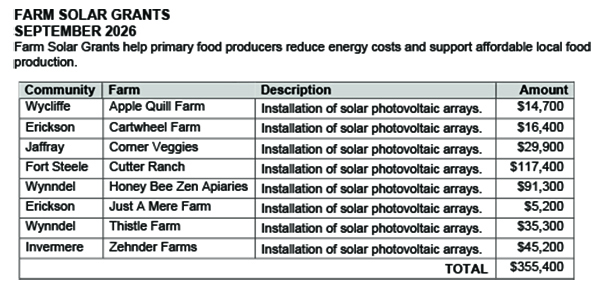
Farm Solar grants help food producers install solar panel arrays on the ground and on farm buildings to power their operations. By lowering energy costs for heating, cooling and running systems like irrigation, these grants help make local food production more affordable for producers and consumers.
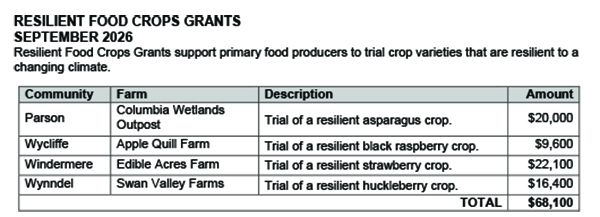
The Resilient Food Crops program supports food producers to trial and transition to crop varieties that may be better able to grow in a shifting climate. Diversifying food production through crop varieties that are not widely grown in a producer’s local area will help make the Basin’s food system more resilient and reliable.
Through the first intake, eight farms will install solar arrays and four producers will plant and test trial crops. These and other programs support the Trust’s goals of strengthening regional resilience and supporting local food production.
Here are some of the projects the Trust is supporting. See all Farm Solar Grants and Resilient Food Crops Grants below.
Farm Solar – Honey Bee Zen
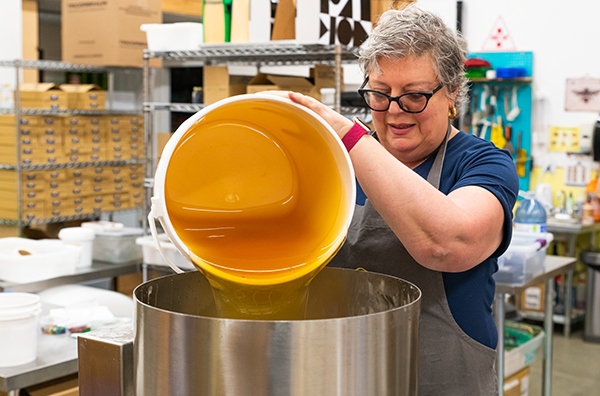
Honey Bee Zen Apiaries in Wynndel manages about 600 beehive colonies and produces honey under the Honey Bee Zen and Swan Valley Honey brands, supplying about 40 stores.
To reduce operational costs and help ensure a reliable power supply during its critical production period between June and October, Honey Bee Zen will install solar arrays on two of its main buildings.
“Solar power for our honey house will be a real benefit for us, especially as we use the most electricity during extraction and production,” said Amanda Goodman Lee, owner of Honey Bee Zen Apiaries with her partner Jeff Lee. “Just as bees harness the sun to navigate, we harness its energy to power our operations.”
Resilient Food Crops – Edible Acres Farm
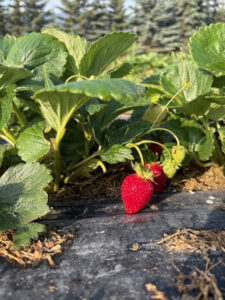
Located in Windermere, Edible Acres Farm is a family-owned and operated farm that produces over 55 varieties of fruits and vegetables for the local community, including berries.
To diversify its local food production, Edible Acres Farm has begun growing hardy strawberry varieties, a crop that is not currently grown at scale in the Columbia Valley. With support from the Trust’s Resilient Food Crops program, owners Lin and Oliver Egan will continue to trial varieties and determine what inputs work best for food production.
“Strawberries are a crop that can be easily preserved and enjoyed year-round when harvested at peak ripeness,” said Lin Egan.
“By experimenting with different mulches, row covers, irrigation methods and crop varieties, we are happy with the results this season and excited to see what next spring brings.”
Columbia Basin Trust supports the efforts of the people in the Columbia Basin to strengthen social, economic and environmental well-being.
To learn more about the Trust’s programs and initiatives, visit ourtrust.org or call 1-800-505-8998.
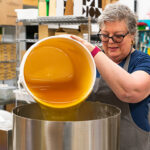
 Lead image: Honey Bee Zen Apiaries in Wynndel will install solar arrays to help lower operational costs and provide a reliable source of power for farm operations. Photo credit: Andrew Bibby Photography.
Columbia Basin Trust