Home »
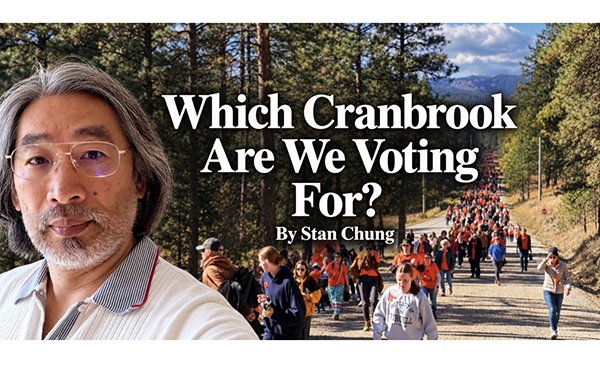
Which Cranbrook are we voting for?
By Stan Chung
Op-Ed Commentary
Cranbrook votes on October 17. After 10 years, let’s ask for more than promises of growth, better services, and careful spending.
We need an account of what our leadership has changed—and why so many problems remain. (cranbrook.ca)
My criticism is of a pattern across successive councils: adversarial relationships with the province, too little ambition in changing how we fund our future, and separate plans that struggle to become one clear integrated vision for community wellbeing.
Housing, jobs, health, downtown, and transportation are connected in our lives. They need to be connected in council’s decisions.
How does this election bring competing ideas about leadership into view? Here is a framework:
Cranbrook 1.0 manages. Keep services running, approve development, and attract investment.
Cranbrook 2.0 improves. Fix the policies, coordinate services, and negotiate better outcomes.
Cranbrook 3.0 builds. Use public land, spending, and partnerships to create lasting jobs, affordable homes, and a healthier community.
We have decent management. But managing the same pressures year after year can become a substitute for changing what produces them.
Housing: approve, improve, or build?
Cranbrook’s April 14, 2025 homelessness count identified 172 people, compared with 116 in 2023. These are minimum snapshots.
On September 8, 2026, council approved a three-year permit for 50 proposed temporary supported homes on Industrial Road 2. Emergency housing matters; preventing the next person from losing a home matters too. (bchousing.org, cranbrook.ca)
Cranbrook 1.0 approves development and seeks provincial help.
Cranbrook 2.0 improves approvals and negotiates affordable units.
Cranbrook 3.0 uses city acquired and existing land and partnerships to help build public, nonprofit, and cooperative housing that stays affordable.
Who has managed growth well? Who has helped create homes people can actually afford?
Food: relieve hunger or reduce the need?
On April 9, 2026, e-KNOW reported that Cranbrook Food Bank had welcomed 567 new clients in 11 months. Growing need leaves volunteers carrying a burden they cannot solve alone. (e-know.ca)
Cranbrook 1.0 leaves hunger largely to charity.
Cranbrook 2.0 strengthens food-bank support.
Cranbrook 3.0 helps build local food production, shared facilities, and cooperative distribution, linking affordable food with local jobs.
Health: ask, organize, or help deliver?
In January 2025, Interior Health announced a planned oncology and renal expansion, then estimated at $59 million, with opening expected in January 2029. Its value will be care received here and journeys families can avoid. (interiorhealth.ca)
The city’s September 22, 2026 update also sought a youth residential detox and treatment centre here or nearby. The nearest youth residential recovery centres were in Kamloops and Kelowna. Distance makes an already difficult family crisis harder. (cranbrook.ca, cranbrook.ca)
Cranbrook 1.0 asks the province.
Cranbrook 2.0 builds regional pressure and follows commitments through.
Cranbrook 3.0 helps create the conditions for local care through worker housing, transport, infrastructure, and patient-support partnerships.
Health bodies deliver treatment. Council must build productive relationships and prepare practical contributions.
What has confrontation secured? Who has turned advocacy into real services?
Jobs and land: announce growth or build lasting wealth?
On April 13, 2026, Cranbrook reported over $243 million in building permits, including more than $200 million in institutional projects. The F.W. Green Home was the largest project. The lasting test is what livelihoods and services remain after construction. (cranbrook.ca)
The former Tembec lands offer a harder lesson. Bought by the city for $3 million in 2018 and sold for $6 million in 2020, the property later became the subject of foreclosure proceedings. October 2025 reporting described roughly $2.3 million owing to the city; in April 2026, the Townsman reported a court-ordered sale. An announced gain became a debt-recovery problem. (e-know.ca, treefrogcreative.ca, cranbrooktownsman.com)
Cranbrook 1.0 attracts buyers and announces expected jobs.
Cranbrook 2.0 strengthens financial checks and tracks actual returns.
Cranbrook 3.0 uses land, purchasing, and ownership partnerships to help grow lasting local employment.
Who has protected public money? Who can explain what they learned when a plan failed?
Budgets: repeat the squeeze or change the choices?
Higher taxes, reduced services, deferred work: how long will these remain our main choices?
Cranbrook 1.0 balances the annual budget.
Cranbrook 2.0 finds savings and improves spending.
Cranbrook 3.0 tests ways to change future budgets: shared services, long-term land income, and investments that prevent costly emergencies.
These options require hard financial work. Where is the sustained effort to give residents better choices?
What leaders have the track record to bring real prosperity here?
Downtown: tidy it or make it thrive?
Council approved its Downtown Revitalization Master Plan on July 10, 2023, including safer walking and cycling, mixed-use buildings, and better access. Its value depends on what gets built and used. (cranbrook.ca)
Cranbrook 1.0 maintains streets.
Cranbrook 2.0 improves public spaces.
Cranbrook 3.0 joins those investments with housing, commerce, culture, and transportation so downtown becomes a place to live, work, and gather.
A collection of plans needs to become a funded and integrated program with clear responsibilities and outcomes.
Candidate Participation question: who is missing?
The city’s 2027 Budget Citizen Survey closes October 2. Surveys offer a way to comment, but they cannot carry community engagement alone. (cranbrook.ca)
Cranbrook 1.0 receives comments.
Cranbrook 2.0 improves consultation.
Cranbrook 3.0 actively brings new voices into decisions through neighbourhood meetings, paid resident panels, and defined budgets residents help allocate.
Renters, younger people, and shift workers need ways to participate that fit their lives—and evidence that participation changes something.
ʔaq̓am: a partnership for the future
On September 18, 2026, BC Wildfire Service announced support for ʔaq̓am, working with Cranbrook, on a proposed 141-hectare prescribed burn. This points toward a larger opportunity: knowledge, enterprise, and new ideas shaping our region’s future. (blog.gov.bc.ca)
Cranbrook 1.0 treats ʔaq̓am as a neighbour to consult.
Cranbrook 2.0 works together on projects.
Cranbrook 3.0 could build an economic partnership respecting ʔaq̓am’s authority and creating shared opportunities in land care, training, tourism, and business.
Candidates differ in style. Some sound forceful; others reassuring. All can promise growth, partnership, and accountability.
Their record tells us what those words mean.
Who has built productive relationships, changed financial choices, joined plans into action, and brought new people into the work?
Years at the table are not enough. Which Cranbrook have they shown us they know how to build?
– Stan Chung, PhD is a writer, speaker, strategic advisor , and 2026 Governor General’s laureate.