Home »
The story behind the four-way stop
By Robin Goldsbury
Op-Ed Commentary
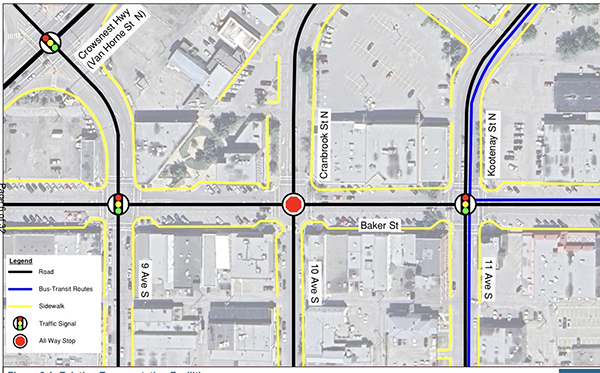
 A number of you have asked me about the removal of the traffic light at Baker Street and 10th Avenue South. I wanted to know too, and thought I’d share my findings. But first, don’t shoot the messenger! This decision predates our current council.
It started with a lightning strike.
In August 2025, an electrical surge from a lightning storm knocked out the traffic signals. The city installed a temporary four-way stop while it investigated the options. Faced with the substantial cost of replacing the signals (more on that below), the city commissioned a traffic study to determine whether they were actually necessary.
The study supported a permanent four-way stop. So In April 2026, the city announced that the intersection would remain a four-way stop, based on the traffic study.
Why on earth does a traffic light cost so much?
I wondered the same thing! Turns out we’re not just buying a few red, yellow and green lights. We’re buying an entire traffic-control system – engineered steel poles, concrete foundations, underground electrical wiring, computerized controllers, vehicle sensors, pedestrian signals, specialized installation and safety testing.
And the costs can be staggering.
In fact, Cranbrook estimated in 2024 that replacing the traffic signals at 14th Avenue North and 2nd Street North would cost upwards of $850,000. I’m told now that light would cost upwards of a million dollars.
While I haven’t verified the exact replacement cost for Baker and 10th, that gives you an idea of the expense involved. That’s serious money. Money that could otherwise help replace aging water and sewer pipes, pave streets or address other pressing infrastructure needs.
When we have millions of dollars in infrastructure requiring attention, we need to ask whether an expensive replacement is necessary or simply what we’re accustomed to.
So why eliminate the turning lanes?
The intersection was also redesigned to have one lane approaching from each direction, eliminating the dedicated turning lanes. The narrower layout is consistent with efforts to make downtown safer and more comfortable for pedestrians. Fewer lanes can simplify vehicle movements and reduce the distance pedestrians must navigate.
It’s part of a broader question about what we want our downtown to be: somewhere people simply drive through, or somewhere they also want to walk, shop and spend time.
Does everyone like the change? Clearly not.
And I understand that. Changing familiar traffic patterns can be frustrating, particularly for people who use an intersection every day. But council also has a responsibility to consider the engineering evidence, public safety and the best use of taxpayers’ dollars.
The question isn’t whether traffic lights are convenient. It’s whether they’re necessary, whether a four-way stop can safely do the job, and whether the additional expense is justified.
That’s the kind of cost-benefit analysis I expect our city to undertake before spending taxpayers’ money.
That doesn’t mean we should ignore problems if the intersection isn’t working as intended. Traffic patterns, pedestrian safety and congestion should continue to be monitored.
The bottom line: The traffic light wasn’t simply removed on a whim. An equipment failure prompted a review, a traffic study supported the four-way stop, and the city adopted a less costly alternative to replacing the signals.
You may agree or disagree with the outcome, but at least you know the story behind the decision.
As always, the opinions expressed here are my own and are accurate to the best of my knowledge.
Original council documentation.
– Robin Goldsbury is a City of Cranbrook Councillor.