Home »

Five economic missteps making your life more expensive
By Stan Chung
Op-Ed Commentary
 For more than a century, the East Kootenay has helped build British Columbia’s prosperity through coal, timber, minerals, and labour. But that wealth has a history rarely reflected in government investment decisions.
Long before mining companies, railways, and governments arrived, Ktunaxa people cared for the land, rivers, forests, wildlife, and resources that made this economy possible.
The Ktunaxa contributed the foundations of regional prosperity while bearing losses that cannot be measured simply in dollars. Their continuing stewardship, knowledge, advocacy, and economic participation remain essential to the region’s future.
Meanwhile, much of the wealth generated here has flowed to distant governments, corporations, and shareholders.
Now Cranbrook must make the case for a replacement high school, expanded cancer and kidney care, and sufficient educators to operate new childcare centres.
After generations of extraction, shouldn’t we measure prosperity by what remains for the people and lands that made it possible?
Here are five economic missteps worth reversing.
- Childcare: Employ Educators Like Colwood Employs Doctors
The mistake: We spend millions building childcare facilities without ensuring enough certified early childhood educators can operate them.
Cranbrook has announced 181 spaces across three projects, including a $13.5-million centre beside Western Financial Place.
A B.C. evaluation found that 30% of surveyed childcare employers experienced unfilled vacancies, while 26% turned children away because of insufficient qualified staff.
The solution: In 2025, Colwood opened a municipal clinic directly employing physicians with salaries, benefits, and pensions. Cranbrook should explore a comparable employment model for certified educators, working with existing operators and the province.
The economic return: If all 181 spaces enabled a parent to work 30 hours weekly at $25 an hour, that represents $7.06 million in potential annual gross wages—equivalent to 118 full-time jobs paying $60,000.
That is the employment income a community might pursue by attracting a factory.
The above estimate is illustrative, but please read that again.
The reversal: Certified early childhood educators are bonafide “economic infrastructure,” not simply a childcare operating expense.
By the Numbers: Cranbrook’s Childcare Opportunity
- 181 spaces announced across three projects.
- $13.5 million for the Western Financial Place centre.
- 30% of surveyed BC childcare employers reported unfilled vacancies.
- 26% turned children away because of staffing shortages.
- $7.06 million annually in illustrative parent earnings, equivalent to 118 full-time jobs.
Earnings assume 30 additional working hours weekly per space at $25/hour, year-round.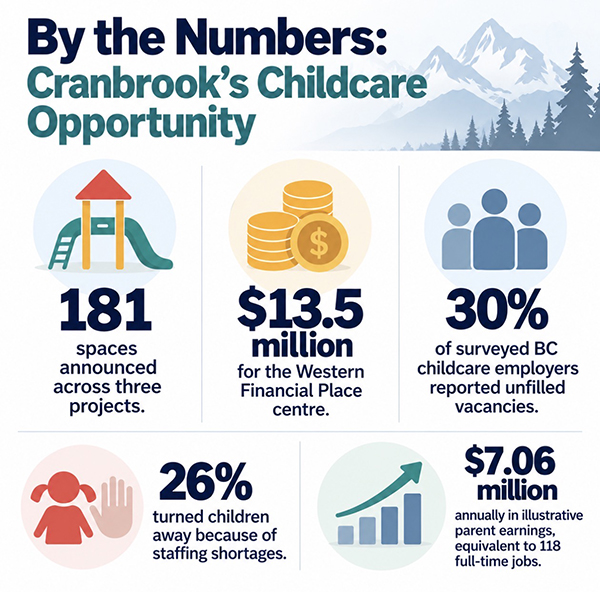
- Mount Baker: Stop Losing the Next Generation
The mistake: We treat replacing Mount Baker Secondary as a building maintenance problem rather than a core investment in Cranbrook’s demographic future.
The school dates from 1952. Its replacement has long been a district priority.
Families deciding where to live consider schools, healthcare, recreation, culture, and opportunities for their children. Employers recruiting professionals face the same questions.
The economic comparison: Retaining 100 households earning an average of $100,000 annually protects $10 million in household income every year, supporting local businesses and services.
This illustrates the economic importance of family retention, not a forecast of the school’s impact.
The solution: Make Mount Baker’s replacement a regional economic development top priority, incorporating modern education, family retention, workforce recruitment, and community use into its business case.
The reversal: A new Mount Baker is not simply a school replacement. It is an investment in Cranbrook’s next generation and continued major project supporter via metallurgical coal.
- Healthcare: Stop Exporting Household Income for Treatment
The mistake: We measure hospital investment by construction costs while often overlooking what families spend travelling for treatment.
East Kootenay Regional Hospital’s planned oncology and renal expansion will bring more specialized services closer to home.
Patients travelling outside the region face fuel, accommodation, meals, missed work, and caregiver expenses.
The economic comparison: If 500 patients avoided five out-of-town trips annually, saving $300 per trip, regional households would retain $750,000 every year, excluding lost wages and caregiver time.
This is an illustrative scenario, not a measured project benefit.
The solution: Complete the expansion, secure specialist staffing, and measure avoided travel, household savings, and employment benefits alongside clinical outcomes.
The reversal: Specialized healthcare is supercharged “economic infrastructure.” It protects household income and makes Cranbrook a more attractive place to live.
- Seniors: Stop Turning Fixed Incomes Into Housing Debt
The mistake: Rising property values appear prosperous while seniors struggle to remain in their homes.
B.C.’s Office of the Seniors Advocate reported a 37% increase in estimated property taxes and municipal charges between 2020 and 2025. More than 83,000 seniors deferred property taxes in 2024/25.
Tax deferral postpones payment but creates debt against the family home.
The solution: Introduce a provincially funded, income-tested property-tax credit limiting annual increases for lower-income senior homeowners to retirement-income growth, and do it without reducing municipal revenues. Senior renters also need protection.
The economic return: Greater housing stability, less debt, and more retirement income available for local spending.
The reversal: Rising property wealth should not require longtime residents to borrow against their homes simply to stay.
- Homelessness: Spend Earlier to Avoid Spending More Later
The mistake: A missed rent payment becomes an eviction, lost employment, emergency accommodation, and greater pressure on public services.
Cranbrook’s 2025 homeless count identified 172 people. Among survey respondents, nearly 30% had lived here their entire lives and another 60% for at least five years. Almost half cited insufficient income as a reason for losing housing.
The solution: Give existing agencies flexible prevention funding and authority to intervene within 72 hours when assistance could avert eviction. Cover urgent arrears, essential repairs, and temporary income interruptions, with continuing support where needed.
The economic return: More households remain housed and employed, with potentially lower emergency costs.
The reversal: Stop waiting until people become homeless to provide assistance that might have kept them housed.
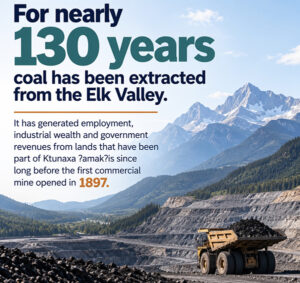 What should remain after a century of extraction?
The East Kootenay has generated enormous economic value. But the costs and benefits have never been distributed equally.
For Ktunaxa people, the losses include land, access, cultural practices, and ecological relationships that no construction budget can restore.
Genuine Reconciliation requires Ktunaxa authority, stewardship, and a meaningful share in decisions and benefits—not merely acknowledgement.
For Cranbrook, the challenge is to turn regional wealth into lasting community well-being.
Childcare enables employment. Schools help families stay. Healthcare reduces household hardship. Housing stability protects incomes and prevents expensive emergencies.
These are not peripheral social expenditures.
They are true Canada Strong economic investments in the people who sustain “a major projects” economy.
After more than a century of extraction, economic development should be measured not only by the wealth we produce, but by the prosperity, opportunity, and healthy lands we leave behind.
– Stan Chung, PhD, lives on Ktunaxa homelands. He is a speaker, writer, strategic advisor, and 2026 Governor General’s laureate.