Home »
B.C.’s voting system falls short again
Letter to the Editor
If you voted in B.C.’s October 24 election and you didn’t vote for a winning candidate, your vote was wasted as far as helping elect anyone. Over the province as a whole, most people’s votes were wasted.
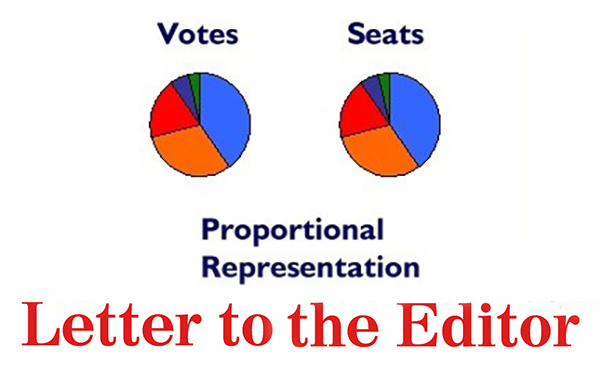
The surprising thing is, it doesn’t have to be a winner-takes-all contest like that. With what’s called proportional representation of voters (PR), almost every vote helps to elect someone of the voter’s favourite political party. PR simply means voters and their parties get their share of elected government representatives according to their share of the votes.
With PR, if a political party such as the Conservatives gets 48% of all provincial votes, they get 48% of the seats in the legislature. That’s the kind of voting used in most democracies around the world. And it’s been shown to produce better government decisions on everything from economic growth to healthcare.
Another flaw of our system is what it does to politicians. Outgoing B.C. Premier David Eby did amazing work as a younger man. He was a defender of the downtrodden as a lawyer. Exactly the sort of person most people would want to run for office and win. He campaigned hard. Rose to the top. Seemingly a win for the good people.
He claimed he supported PR in 2009 yet in 2018 as the Attorney General during B.C.’s most recent referendum on voting reform, he dutifully served the NDP in pretending to support fair voting while actually sabotaging it by a variety of means: Grossly inadequate financing for informing the public; giving equal financing for fearmongering publicity on behalf of unfair voting; giving no personal support to fair voting; and designing a referendum ballot with so many choices it clearly conveyed that the government itself had no idea what was best for B.C.
Looking back historically in Canada, politicians have often said they favour modern, fair voting when they’re still in opposition, and then dropped their support for it when they form government. Why? It’s because when they win they suddenly decide they want to keep the old system that gave them power with less than half the popular vote.
Politicians of both left and right are forever tempted to accept “the end justifies the means” to succeed in politics. In September B.C.’s governing New Democratic Party tried an old trick: calling a snap election, including a short campaign period, while the opposition was in disarray with a headless leadership. This is widely believed to have been a cynical twist of the democratic process, subverting the serious and lengthy policy discussions that campaigns ought to involve.
However, cabinet minister Bowinn Ma, a rising star in the NDP who gave up her engineering career to serve the public, defended the election call. She argued that the legislature needed a stronger majority to function effectively. That is not true; many legislatures around the world, typically those with PR, work messily but effectively without one political party having a majority of seats. Nevertheless, she got her wish, though not with the party she wanted achieving unrestricted power.
The 2026 NDP campaign began and ended with fearmongering, starting with Donald Trump. It even stooped to accusing candidate Mike Hicks of wanting to conquer First Nations when he said we need treaties. Mud-slinging is a common and often successful strategy but it is an American style and rather unCanadian because it short-circuits serious democratic discussion. Voters should be discouraging it, and this time they did so – they elected Hicks.
PR doesn’t prevent attack politics but in practice it reduces it, believed to be one reason it attracts and elects more women.
Because of the way our pre-modern voting system works, the BC Conservative Party will have about 68% of the 93 legislature seats, even though they garnered less than half of the popular vote overall — only 48%.
How else could it have gone? If people voted exactly the same way, but with the votes counted by a proportional system, the BC Conservatives would have had only 45 seats instead of 63, the NDP 35 instead of 28, the BC Greens 10 instead of two, CentreBC two instead of zero, and OneBC one instead of zero. (Mail-in and absentee ballots to be counted by Nov. 6 might change this slightly, but probably not.)
If the Conservatives provided a MLA to be the Speaker of the Legislature, as is customary, they would then have been left requiring the assent of three MLAs from other parties in order to get a bare majority (47 votes) to pass legislation. As a minority government they would have been forced to hold thorough and full public discussion of policy and legislative changes. Or alternatively, the BC NDP and BC Greens might have joined in a coalition of 45 seats and formed a minority government. PR encourages better manners and cooperation between politicians, partly because they know they may need to form a coalition.
It must be acknowledged that proportional representation might have led to a change in the popular vote. PR would make almost every vote count to help elect a member of one’s preferred party, reducing the fears of vote splitting and wasted votes.
That can shift who people vote for, and with a slight shift the BC NDP and BC Greens may have formed a majority coalition government under PR. Admittedly the BC Conservative voters would have been less pleased with that. Also, PR increases voter turnout because people know their vote won’t be wasted.
As it is, with our out-of-date electoral system the BC Conservatives will have 100% of the power and require no cooperation from anyone except the members of their own caucus. They’ll be held accountable for good or bad in four years.
Most of us didn’t vote for CentreBC or OneBC and they were shut out. No doubt many feel that’s a good thing and they would be an irritation if elected, but fair democracy would mean their tens of thousands of supporters deserved at least a token voice in Victoria to help hold the government accountable.
Even those who don’t agree with such an argument of fairness and accountability ought to remember that proportional representation has been shown to produce better governance for the environment, economic growth, healthcare, and other essential aspects of government in practice. The practical results are what should count aren’t they?
More info at Fair Voting BC, Fair Vote Canada, and similar organizations!
Maxwell Anderson,
Chair, Voting BC