Home »
Make money while you sleep
Why we need a capitalism that produces more capitalists
By Stan Chung
 Op-Ed Commentary
What kind of democracy makes it harder to become a voter? What kind of education system makes it harder to become educated? And what kind of capitalism makes it harder to become a capitalist?
I recently read this: “Perhaps we need a more ambitious form of capitalism.”
Ambitious? I’d settle for competent.
For decades, conservatives have asked us to sacrifice our collective wealth in the name of capitalism.
Gut healthcare. Cut education. Lower corporate taxes. Strip environmental protections.
Fine. Where are all the new capitalists?
If conservatives are so good at capitalism, why aren’t more of us rich?
I don’t mean people with honking trucks, enormous mortgages and six-figure salaries. I mean people who own things that generate wealth while they sleep.
People who own businesses, shares, investments, intellectual property and productive assets. People whose children inherit opportunities rather than debts.
How embarrassing
Consider Denmark.
According to international wealth reports from UBS and Allianz, Denmark has:
- 38% more median wealth per adult than Canada.
- 31% more average wealth per adult.
- Approximately 25% more US-dollar millionaires per capita, based on 2024 estimates.
- 46% more net financial wealth per person, excluding real estate.
Denmark achieves this with higher taxes, tuition-free universities, subsidized childcare, stronger unions and extensive public services.
Are you kidding me?
And it does so without anything approaching Canada’s abundance of natural resources.
If you think Denmark’s wealth is simply a matter of generous pensions and expensive houses, consider how many more founders of billion-dollar companies these countries produce per capita compared with Canada, according to Dealroom’s research on founders’ countries of origin:
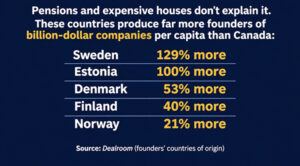 Sweden: 129% more.
Estonia: 100% more.
Denmark: 53% more.
Finland: 40% more.
Norway: 21% more.
How embarrassing not just for Canadian conservatives but for the rest of us pulling shifts and eating hamburger on weeknights.
Countries we might dismiss as excessively socialist are outperforming us at producing wealthy citizens and world-class entrepreneurs.
Perhaps our problem is not too much socialism. Perhaps our problem is insufficiently ambitious capitalism.
Why should we accept becoming collectively poorer without compelling evidence that more of us will become individually wealthier?
Looking rich is not being rich
A job is not capital. A salary is not equity. Shopping is not ownership.
A person earning $150,000 a year who owes nearly everything they own to a bank may be less wealthy than someone earning $60,000 who owns their home, has investments and carries little debt.
Income pays for your life. Wealth gives you greater choices.
Isn’t there a difference between earning money and owning something that makes money?
Isn’t there a difference between working for a profitable company and owning part of a profitable company?
A salary can change your life. Ownership can change the lives of your children.
Why aren’t we teaching our children this distinction?
Why is learning how to become an employee such a central part of our education system, while learning how to become an owner is almost an extracurricular activity?
A more ambitious capitalism would make ownership more important.
Wealth we already own
One of the great acts of economic deception is convincing Canadians that public wealth is not wealth.
A public university is wealth. A hospital is wealth. A library is wealth. A publicly owned electrical utility is wealth.
Consider how collective wealth protects and creates private wealth:
Public healthcare protects families from financially devastating medical bills.
Affordable childcare allows parents to pursue careers and accumulate savings.
Affordable education allows young people to accumulate capital instead of repaying enormous debts.
Public infrastructure reduces the cost of doing business and creates opportunities for entrepreneurs.
Why would a competent capitalist want to destroy these advantages?
Making ordinary people poorer in the name of making them richer is economic stupidity.
Unless, of course, making ordinary people richer was never the objective.
The frightening cost of getting rich
There is another form of wealth that our economic debates routinely disregard.
Natural wealth.
A forest is wealth before anyone cuts it down.
Selling a forest does not necessarily create wealth. It converts natural wealth into financial wealth.
The money can leave. The loss stays.
A mining company can distribute profits to shareholders while leaving future generations with the cost of managing contaminated water.
A corporation can become richer while a community becomes poorer.
Taking something we collectively own and converting it into private profit is not necessarily wealth creation. Sometimes it is simply wealth changing hands.
Sometimes it is wealth destruction.
A capitalism that cannot distinguish between creating wealth and liquidating a life-giving inheritance is a remarkably primitive form of capitalism.
 We are told that environmental sacrifices are necessary for economic prosperity.
Again, whose prosperity?
Show us what we collectively gained. Show us who owns it. Show us what remains for our grandchildren.
You cannot count the fortune and ignore the cleanup bill.
And then there is poverty
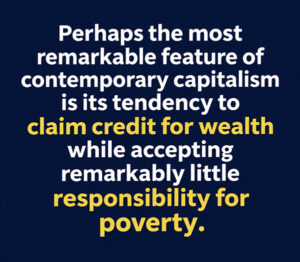
Perhaps the most remarkable feature of contemporary capitalism is its tendency to claim credit for wealth while accepting remarkably little responsibility for poverty.
When a billionaire emerges, we celebrate capitalism. When thousands of people cannot afford housing, we blame individuals, governments or social circumstances.
An economic system cannot take credit for its successes while disowning its failures.
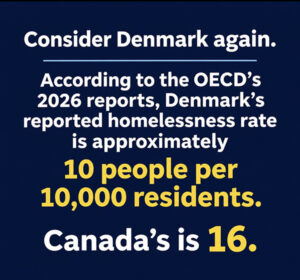 Consider Denmark again. According to the OECD’s 2026 reports, Denmark’s reported homelessness rate is approximately 10 people per 10,000 residents. Canada’s is 16.
Countries count homelessness differently. But Canada’s own performance should alarm us. Between 2020 and 2025, the number of people counted as homeless in participating communities rose from approximately 41,000 to 65,000.
Meanwhile, Denmark produces more founders of billion-dollar companies per capita than Canada.
Apparently, producing extraordinarily successful entrepreneurs and protecting ordinary people from destitution need not be competing ambitions.
Human dignity is not something we should have to earn. Nobody should have to prove their economic usefulness to deserve a home, a meal, healthcare or a life free from humiliation.
The purpose of creating wealth should be to enhance human dignity, not make dignity conditional upon wealth.
But even by its own economic standards, capitalism should be ashamed of its performance.
A society that leaves human talent sleeping on sidewalks has no business congratulating itself on the intelligent allocation of capital.
Imagine the artists who never painted, the scientists who never discovered, the businesses never started and the children whose gifts went undiscovered because their families were struggling to survive.
What a colossal waste of human possibility.
Is capitalism going to clean up the mess? Is it even prepared to acknowledge its part in creating it?
Give us real capitalism
 I want a capitalism that makes it easier for a nurse, a carpenter, a teacher and a grocery store employee to accumulate meaningful wealth.
I want children from poor families to have genuine opportunities to become business owners and investors.
I want more Canadians to own the companies, buildings, technology and infrastructure that generate our national prosperity.
I want more Canadian entrepreneurs to build and sell successful businesses and create generational wealth.
Measure capitalism’s success by how widely private wealth spreads, how much public wealth is protected, how much natural wealth survives and how well human dignity is protected.
We have been asked to make enormous sacrifices in the name of capitalism by people who seem remarkably incompetent at making us wealthy.
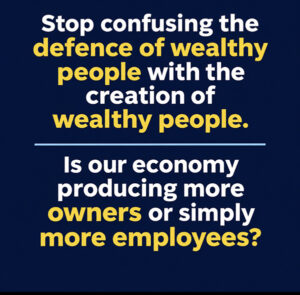
Stop confusing the defence of wealthy people with the creation of wealthy people.
Is our economy producing more owners or simply more employees?
References
UBS (2026). Global Wealth Report 2026.
UBS (2025). Global Wealth Report 2025.
Allianz (2026). Global Wealth Report 2026.
Dealroom. Founder Origins: Where Billion-Dollar Founders Come From.
OECD (2026). Data on Homelessness and Housing Exclusion: Canada.
OECD (2026). Data on Homelessness and Housing Exclusion: Denmark.
OECD (2026). OECD Economic Surveys: Denmark 2026.
Sae Hoon Stan Chung, PhD (he/him)
[email protected]
https://linktr.ee/Chungstan
Scholar/Advisor/Speaker
2026 Governor General Laureate
Chair, Royal BC Museum Past
Past Chair, BC Arts Council
Past CAO ?a’qam First Nation
Past Advisor, Ktunaxa Nation
Past VP Academic + Research