Home »
Food security takes root in Cranbrook
By Robin Goldsbury
Op-Ed Commentary
 Cranbrook is cooking up something pretty special! Growing lettuce in the middle of a Kootenay winter. Turning would-be garbage into thousands of nutritious meals. Helping budding food entrepreneurs get their businesses off the ground. Welcome to Cranbrook’s evolving food economy!
City council last week adopted our Community Food Charter into Cranbrook’s Official Community Plan (OCP). It generated some interesting discussion around the Council table, including whether food security is even in the City’s lane.
So, a little food for thought… What exactly did we pass?
Development of Cranbrook’s Community Food Charter began in 2023, supported by a $15,000 Healthy Communities grant. More than 25 community representatives and residents contributed to its development.
The charter is a shared vision, values and priorities for building a healthy, accessible, sustainable and resilient local food system here in our city. Food security was already identified in our Official Community Plan. Incorporating the charter builds upon that foundation, providing further direction for future municipal planning and decision-making.
Food is a fundamental human right
 During council’s discussion, I argued that access to adequate, nutritious food is a basic human right. It’s a right recognized since 1948 under the United Nations’ Universal Declaration of Human Rights in 1948 and reinforced in 1976.
Good nutrition is fundamental to childhood development, learning, its essential to physical and mental health, productivity and quality of life. It’s the most basic of human needs.
Food security is much more than having enough to eat. It’s about having reliable access to safe, nutritious, affordable and culturally appropriate food.
And some rather exciting things happening in Cranbrook!
From farm to fork – and everything in between!
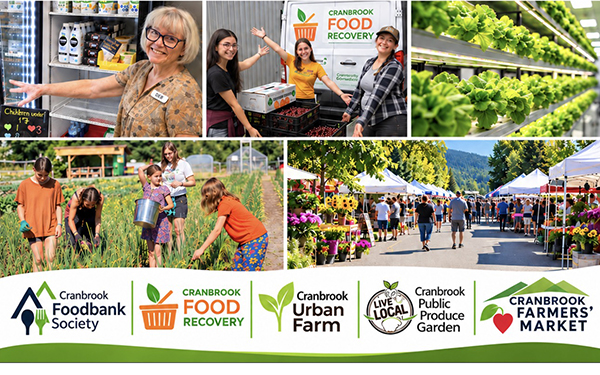
The Kimberley Cranbrook Food Network brings together an impressive collection of community organizations, entrepreneurs, agricultural producers and volunteers. We’re growing food, recovering food, processing food, preparing food, marketing food and delivering food.
- Cranbrook Food Bank: Serving over 2,600 individuals annually, approximately one-third of whom are children, with over 19,000 annual visits. (My apologies – a correction to the statistics I quoted at the last council meeting.)
- Cranbrook Food Recovery: Turning potential waste into community wealth! In 2025, the program distributed 201,734 pounds of food to local charities, redirected another 96,598 pounds to local farmers and produced 21,512 servings of community meals.
- Cranbrook Urban Farm: Growing fresh lettuce year-round using innovative hydroponic technology. This social enterprise is helping to fund other food initiatives.
- Harvest Haul: Connecting regional farmers, ranchers and food producers with consumers through seasonal produce, meat and grocery boxes. More local food. More local business. More dollars circulating in our regional economy.
- Farm Kitchen: Helping aspiring food entrepreneurs overcome one of their biggest financial hurdles – the cost of commercial kitchen facilities.
- Salvation Army: Providing approximately 4,200 meals every month, including school lunches, community meals and meals delivered to residents unable to leave their homes.
Throw in our farmers’ markets, community gardens, school food programs, cooking education and a massive army of dedicated volunteers, and we have quite an impressive local food system taking shape.
Something BIG is cooking!
Under construction at 701 Cranbrook Street North is the new Cranbrook Food Innovation Centre, anticipated to open in 2027. This exciting initiative of the Community Connections Society of Southeast BC will bring together commercial kitchens, food recovery, food processing, bulk storage, refrigeration, meal preparation and distribution.
Shared commercial infrastructure will also help entrepreneurs develop new products and launch businesses without the enormous upfront investment traditionally required.
I’m excited about the possibilities for local specialty foods, value-added agricultural products and new business ventures!
But is food security in the city’s lane? An interesting question raised at last night’s council meeting.
Certainly, addressing poverty and income insecurity falls primarily within the responsibilities of provincial and federal governments. However, Section 7 of B.C.’s Community Charter specifically identifies fostering the economic, social and environmental well-being of our community as one of the purposes of municipal government.
B.C.’s Local Government Act also expressly permits municipalities to incorporate policies addressing social needs, community well-being and agriculture into their Official Community Plans.
Municipalities make decisions every day that influence our local food system.
• Where can food be grown?
• Where can it be processed?
• What businesses can operate and where?
• Are our regulations unnecessarily restrictive?
• How accessible are our food resources?
These are municipal matters.
What does this mean for city operations and taxpayers?
Adopting the Community Food Charter does NOT mean establishing a new city department, hiring more staff or getting into the grocery business! Nor does adopting the charter, in itself, authorize new expenditures.
What it does provide is a policy framework to help guide future decisions in areas where the city already has responsibilities:
• Land use, zoning and development planning.
• Business regulations and permitting.
• Economic development and entrepreneurship.
• Transportation and accessibility.
• Waste management and environmental sustainability.
• Emergency preparedness.
• Community partnerships and external funding opportunities.
We have an exceptionally capable network of organizations already doing the heavy lifting. The city can help facilitate, collaborate and remove unnecessary barriers rather than duplicate their efforts.
What’s in it for Cranbrook?
Quite a lot, potentially!
- Economic development: New businesses, employment opportunities and investment.
• Affordability: Improved access to affordable, nutritious food.
• Public health: Better nutrition and healthier residents.
• Environmental stewardship: Less food waste going into our landfill.
• Emergency preparedness: Greater local food resilience when wildfires, highway closures or other emergencies disrupt supply chains.
• Regional agriculture: Stronger markets for our local farmers and producers.
• Innovation: Opportunities for new technologies, food processing and value-added products.
• Community development: Volunteerism, education, skills development and stronger community connections.
More than a food bank. More than a food charter.
What excites me most is the ingenuity, entrepreneurial spirit and collaboration happening right here in Cranbrook. We have people tackling social challenges with innovative business models, turning waste into valuable resources, creating opportunities for entrepreneurs and building a more self-reliant community.
Food security is about building the capacity of our community to put food on the table tomorrow. And that’s certainly something worth celebrating!
Want to learn more about what’s cooking in Cranbrook?
www.kimcranfood.net
www.ccscranbrook.ca
www.cranbrookfoodrecovery.com
As always, the opinions expressed are solely my own, and the information provided is accurate to the best of my knowledge.
– Robin Goldsbury, MSc, is a Cranbrook City Councillor