Home »
Following Earth Day – Lyrid Meteor Shower Night
By Dan Hicks
Our annual Lyrid Meteor Shower (pronounced “ly-rid”) is active from April 14 to 30; the peak 2026 nights being April 21 and 22 when up to 20 meteors per hour might be observed from under a reasonably dark rural sky, descending into our atmosphere at 49 kilometres per second, these particles heat up to 1,650C whereupon they vaporize as meteoric smoke (in contrast, the Artemis 2 Orion capsule’s maximum April 10 re-entry speed was 11 km per sec).
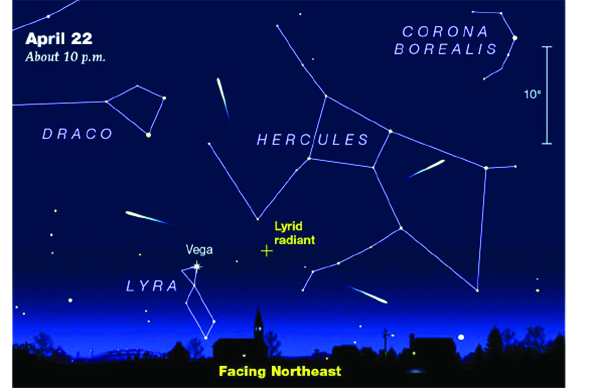
As shown on the chart, Vega – guiding star to the Lyrid radiant, will rise into Cranbrook’s northeastern sky by 22:00 MDT, heralding the arrival of ever more meteors through the night, until true night ends at 04:27 on April 23 when Vega and the Lyrid radiant will have risen high into our southeastern sky – yielding an optimal above-horizon perspective which serves to maximize our Lyrid Meteor Shower viewing.
As seen from our Cranbrookian latitude, Vega is the third brightest star in our night sky and the alpha star in the Summer Triangle asterism. The Lyrids’ precise meteoric peak occurs at 14:00 MDT on April 22.
The Lyrid Meteors’ parent body, Comet Thatcher (C/1861 G1), has an orbital period of 415 years, last visited us in AD 1861, and will return again in AD 2283 (we must endure a 257-year wait).
Sources: Sky & Telescope April 2026 (chart et al), Amsmeteors.org, & RASC Observer’s Handbook. Space.com (below).
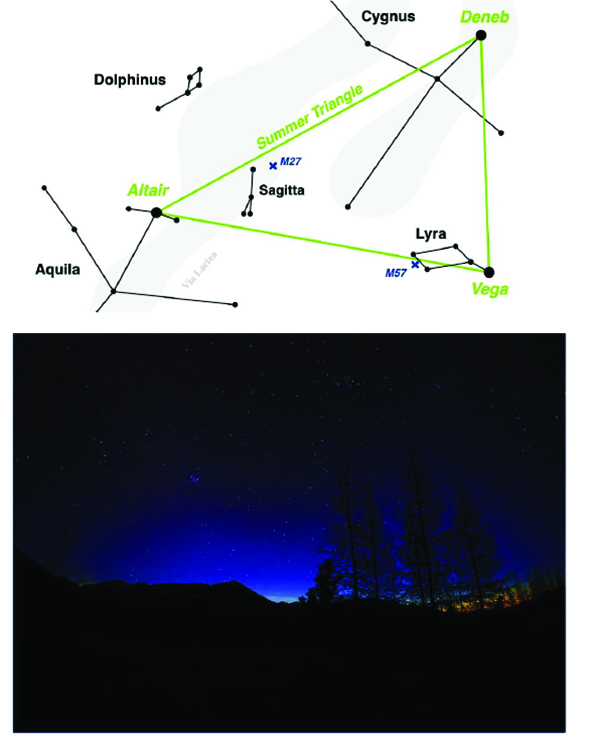 Peaceable Purcell sunset: The Haydes & Pleiades appear (left) as the sun sets behind the Purcells (right), looking west from Windermere. April 2026. Robert Ede photo (palliserpass.ca).