Home »
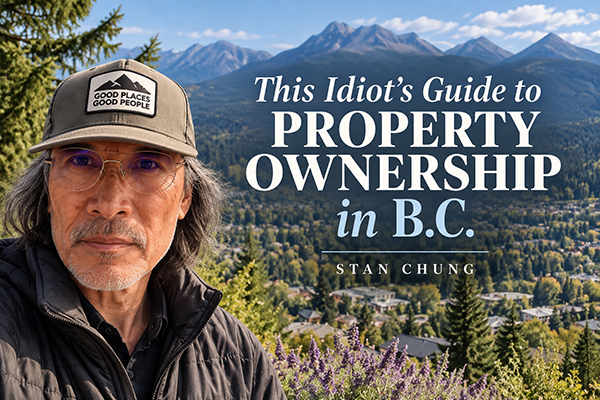
This Idiot’s Guide to Property Ownership in B.C.
By Stan Chung
Op-Ed Commentary
I own a house in Cranbrook.
We love our house. It is an infill house on a small lot downtown. We planted purple sage instead of grass, and we like to think we are half-decent neighbours.
So, what the heck do I exactly own?
That question has become surprisingly angry since the Cowichan decision. Some people hear Aboriginal title and think their property title is on fire. Others say there is nothing to worry about. Neither helps me much.
So here is my attempt.
I have registered title to my property. But that has never meant I have every right or every authority connected to that little piece of ground.
The City of Cranbrook decides what I can build on it. If I don’t pay my property taxes, a legal process can eventually sell my property.
If I have a mortgage and stop paying it, the bank can go to court. I can lose my house.
Those are real honkin’ powers over my property.
They exist because Canadian law gives governments certain powers and because, when I take out a mortgage, I give the bank a legal interest in my property.
Aboriginal title is NOT another version of either of those things.
An Indigenous Nation does NOT become another municipality, taxing authority or mortgage holder with a general power to take my house.
There is no general jurisdiction created by Aboriginal title, DRIPA or UNDRIP that simply allows an Indigenous government to take a homeowner’s fee-simple property.
That distinction is real. My title can be real while other rights are also real.
Look, I can stand in the purple sage in my own yard and still not necessarily own the minerals underneath my feet. Mineral rights can be held separately.
Even airspace can have separate legal rights.
None of this is unusual. The same place can have different rights and different authorities attached to it.
Two things can be true at the same time.
Hmm. Maybe that is the part we are having trouble with.
This week, eleven former B.C. attorneys general put one part of the current argument in unusually plain language: “Modern treaties provide a negotiated framework for recognizing Indigenous rights while preserving the security of private property. They do not displace ordinary homeowners or businesses from their fee-simple lands.”
That statement is about modern treaties. Cowichan raises a different and harder question about Aboriginal title.
Aboriginal title is not a mineral right. It is not airspace. It is not municipal zoning. And it is not simply another property title.
It is a constitutionally protected Indigenous right to land.
Cowichan did not invent it. Neither did DRIPA or UNDRIP.
This is where the acronyms confuse almost everybody.
UNDRIP is the United Nations Declaration on the Rights of Indigenous Peoples. It describes international standards for Indigenous rights, including lands, resources, culture, self-determination and decision-making.
Canada passed its own federal UNDRIP Act in 2021. It requires the federal government, working with Indigenous peoples, to take measures to make federal laws consistent with the Declaration.
BC passed DRIPA in 2019. It requires the provincial government, also working with Indigenous peoples, to take measures to make BC laws consistent with the Declaration.
Underneath both is section 35 of Canada’s Constitution, which recognizes and affirms existing Aboriginal and treaty rights.
Cowichan, then, is not a case where DRIPA suddenly gave a First Nation a new land right. Aboriginal title existed in Canadian constitutional law before DRIPA.
But Cowichan has made the property question real for many people because the decision deals with Aboriginal title in an area where private property interests also exist.
That is exactly why people are asking hard questions.
The legal relationship between those interests is complicated. The decision is being appealed. We should not pretend every question has already been answered.
But neither should we turn that uncertainty into a power that does not exist and say Indigenous governments can simply take people’s houses.
So why are people talking about repealing DRIPA?
For some British Columbians, repeal sounds like a way to restore certainty. One law for everybody. One government making the rules. No special rights based upon who your ancestors were.
I understand the appeal of that argument.
But rights are not decided by majority rule.
That is rather the point of having rights.
If the majority could decide which rights a minority gets to keep, they would not be rights in any meaningful sense.
We understand this in other parts of Canadian life. The dignity and equality of people with disabilities are not conditional on whether most people find accommodation convenient. Racialized people do not have to win a referendum to be protected from discrimination.
Human rights exist in part because history has taught us what can happen when the dignity of a minority depends entirely upon the goodwill of the majority.
Aboriginal and treaty rights are not identical to disability rights or protections against racial discrimination. They have their own constitutional history and legal foundation. But they share something important: their existence is not determined by whether the majority approves of them.
Section 35 recognizes and affirms Aboriginal and treaty rights in the Constitution itself.
Now listen to how “repeal DRIPA” can sound from the other side.
Indigenous peoples were here before British Columbia. Their governments did not disappear when settlers arrived. Their relationships with their lands did not disappear. They did not voluntarily surrender their rights simply because another government became powerful enough to occupy and govern the territory.
Much of the wealth of colonial governments came—and still comes—from land and resources.
Forests. Minerals. Water. Hydro. Agriculture. Cities. Roads. Real estate.
So saying we should all be treated exactly the same now can hide a difficult history: we did not arrive at the same place in the same way.
And Indigenous people are telling us that this isn’t merely history. Racism, dispossession and their consequences continue.
Two things can be true here too.
I don’t want an answer that makes my house less secure. I love where I live.
But I also don’t want the security of my little lot in Cranbrook to depend upon pretending another people’s land rights don’t exist.
That doesn’t answer every question about DRIPA. It doesn’t mean every Indigenous claim must prevail.
It certainly doesn’t tell me exactly what Cowichan will eventually mean for a homeowner.
And asking questions about property rights isn’t racist.
We have reached the part where disagreement is OK: it matters.
I have come to think that clarity is sometimes created by conflict. Not the conflict where we shout racist from one side and special rights from the other.
The useful conflict begins when I can state your concern accurately enough that you recognize it—and you can do the same with mine.
A property owner should understand why an Indigenous person might hear “repeal DRIPA” as something much more painful than repealing a provincial statute.
An Indigenous person should be able to hear why someone who spent thirty years paying for a home wants a clear answer about the security of that title.
Neither person has to surrender the question.
That may be what B.C. needs now. Not less disagreement. “Better” disagreement.
Because the hardest thing underneath Cowichan may not be deciding which of two things is true.
It may be accepting that two things can be true at the same time.
My property rights are real. Indigenous rights are real.
The difficult work is figuring out how both live on the same ground. We won’t get clarity by making one of those realities disappear.
We have tried settling land questions that way before—by deciding whose rights counted and whose could be ignored.
That is not how we move forward.
The better way is to know two things can be true at the same time, and that honest, respectful conflict can be productive.
– Stan Chung, PhD, is a Cranbrook-based writer, strategic advisor, speaker and a 2026 Governor General’s laureate