Home »
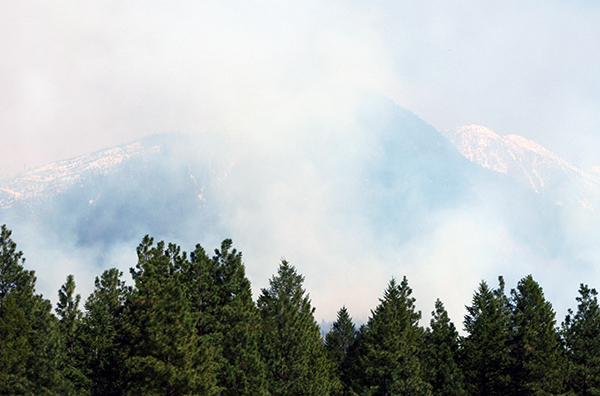
Could Cranbrook help prevent the next wildfire?
By Stan Chung
Op-Ed Commentary
 Every summer we become better at staying inside.
Lightning flashes across the Rockies. Satellites watch from space. Cameras scan mountain ridges.
We can often predict where tomorrow’s fires are most likely to begin—right where we live. Right here. Right now.
Must mitigation begin after the first tree is burning?
When a dry lightning storm crosses the East Kootenay, we wait for the strike. We search for smoke. We race to contain the fire before it outruns us.
Perhaps the next frontier is not better prediction.
Perhaps it is preventing a few of those strikes from ever becoming wildfires.
Today, researchers are exploring technologies that guide lightning, autonomous systems that respond without waiting for people, and artificial intelligence that can identify where the greatest risks are emerging. None has yet demonstrated that it can meaningfully reduce lightning-caused wildfire ignitions at scale.
But together they point toward a different question.
What if we invested as much imagination in preventing wildfire ignitions as we have in predicting and fighting them?
Canada already spends billions every year responding to wildfires—on aircraft, firefighters, evacuation centres, emergency response and rebuilding. We continue to invest heavily in predicting where the next fire will begin.
Imagine directing even a small fraction of that effort toward prevention.
Not replacing prescribed burns or fuel reduction, which remain essential. Adding a new layer of research.
Start with something practical.
Build a research network of simple lightning-reception towers across one high-risk corridor in the East Kootenay.
Place them where decades of wildfire records, lightning maps, prevailing winds, topography and fuel conditions suggest the risk is greatest.
Instrument every tower. Measure every storm. Learn what works. Learn what doesn’t.
Perhaps the towers do nothing.
Perhaps they become platforms for tethered conductors, autonomous drones or technologies no one has imagined yet.
Imagine.
That is how engineering advances. Not by waiting for certainty, but by building the first prototype.
The first step is not a tower.
It is a table.
Around it sit Ktunaxa knowledge holders, BC Wildfire Service, BC Hydro, utilities, engineers, atmospheric scientists, universities, artificial intelligence researchers, mining companies, aviation experts and local governments.
Across the table lie 50 years of lightning maps, wildfire records, weather patterns and satellite imagery.
There is only one question.
Can we reduce the number of lightning-caused wildfires before the first tree ignites?
If the answer is no, Canada will understand wildfire better than it does today.
If the answer is yes—even by a few percent—the return for forests, communities, wildlife, public safety and taxpayers would be enormous.
The last century built highways, dams and power grids.
This century may be remembered for building something visionary: infrastructure designed not to fight the next wildfire, but to prevent the next ignition.
Someone will set that table. A table to discuss among other things—a network of lightning strike reduction towers.
Drone firefighting companies headquartered in B.C. have been funded. The Japanese are testing drone tethered lightning towers.
Why isn’t British Columbia studying whether a network of grounded towers, electric-field sensors, and emerging lightning-guidance technologies could reduce ignitions near vulnerable communities?
And why shouldn’t this research be centred here?
– Stan Chung, PhD lives in Cranbrook. He is a writer, strategic advisor, speaker, and a 2026 Governor General’s laureate.