Home »
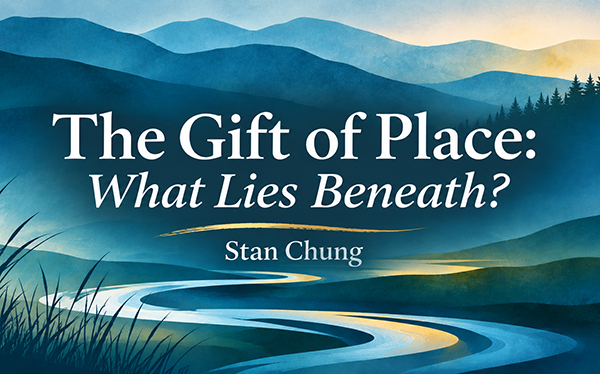
The Gift of Place: What Lies Beneath?
By Stan Chung
Op-Ed Commentary
 Joseph Creek winds through Cranbrook over stones and grassy banks. It looks like a creek. We ask it to behave like a drain.
What if the most valuable thing Cranbrook could build is something it once had?
By 1865, the Dewdney Trail reached from Hope to the Wild Horse Creek goldfields near present-day Fort Steele.
Near its eastern end was ʔa·kiskaqɬiʔit, the Ktunaxa name for Cranbrook: “where two trails meet on the prairie.”
Ktunaxa scholar Joyce Green writes that names carry histories, relationships and law. In the Ktunaxa creation account, Naǂmuq¢in travelled through the territory naming places before becoming the Rocky Mountains.
This was not an empty landscape awaiting an economy.
By the 1880s, Ktunaxa people at Joseph’s Prairie had nearly 2,000 horses and 500 cattle. Chief Isadore reportedly owned more than 300 horses and 100 cattle, cultivated wheat, oats and potatoes, and maintained a fenced farm.
In 1885, Colonel James Baker acquired property on Joseph’s Prairie and subsequently fenced Isadore out of traditional grazing lands. The dispute helped precipitate the Kootenay Crisis of 1887. (Read more.)
Colonial settlement did not teach Isadore how to prosper. It claimed the power to decide whether his prosperity could continue.
Who Could Give Away a Homeland?
Green recounts an 1884 encounter between Ktunaxa Chief David and reserve commissioner Peter O’Reilly.
O’Reilly claimed Crown authority to allot reserves. David challenged the notion that anyone could give the Ktunaxa people land that was already theirs. He asked that Isadore and other chiefs participate. O’Reilly refused.
David described a homeland crossed by an international boundary dividing families:
“Who are you to run a line through my house and divide my children?”
They reached no agreement. Reserve boundaries were imposed anyway.
The dispute was not simply about acreage. It was about who possessed the authority to define a place, its value and its future. That question remains inside development approvals, resource permits and public budgets.
The Strange Arithmetic of Destruction
I have spent years helping institutions make decisions about budgets and public services. We carefully price what we build, but seldom calculate what disappears.
Imagine a wetland drained for housing. Contractors are paid, homes sold, and taxes collected. Years later, runoff threatens those homes. Government pays for culverts and flood protection.
Both rounds of spending count as economic activity. The wetland that once stored water without sending an invoice has vanished.
We count destruction and repair as growth. Private profits can be secured while the costs of damage fall on households and taxpayers.
What a municipality collects is not necessarily what a community gains.
Worse, institutions may authorize ecological destruction without accounting for its full cost or recognizing the Indigenous authority governing the place.
What Restoration Makes Visible
Near Fernie, known in Ktunaxa as Ȼaqahak, the Elk River appears clear beneath the mountains. Yet selenium associated with coal mining can damage fish reproduction without visibly clouding the water.
Yaq̓it ʔa·knuqⱡi’it First Nation, based near Grasmere, is among the Ktunaxa governments with interests in the watershed.
Mining companies profit from extraction. Who determines acceptable harm, measures recovery and pays if treatment fails?
Sometimes we cannot see what development has damaged. Sometimes we cannot see what nature provides until we lose it.
West of Kimberley, the 2026 Matthew Creek wildfire burned approximately 1,826 hectares, an estimated 30 to 40 percent at high severity. Matthew Creek supplies roughly one-fifth of Kimberley’s drinking water.
The fire exposed risks of erosion, sediment and changing water flows, prompting research and planning.
A forest should not have to burn before we recognize it as water infrastructure. Its value exists before anyone calculates the cost of replacing its services.
When Salmon Return
In May 2026, children gathered near Lake Windermere to release young sockeye salmon. Shuswap Band hosted the event as part of Bringing the Salmon Home, led by the Secwépemc, Ktunaxa and Syilx Okanagan Nations.
Did you know that the Grand Coulee Dam has blocked salmon passage to the Canadian Upper Columbia since 1939?
Two tagged sockeye released as fry in 2023 were detected returning as adults near Wells Dam in Washington in 2025.
They survived the ocean journey but could not reach their ancestral Canadian waters.
Imagine a salmon travelling thousands of kilometres only to meet a wall built by people who called the electricity and irrigation it produced progress.
Washington offers another possibility for study. The Lower Elwha Klallam Tribe fought for decades to remove two dams from the Elwha River. By 2014, more than 70 miles of salmon habitat had reopened. Former reservoir beds lay exposed, vegetation returned, and sediment began rebuilding the river mouth.
Then the salmon came. In 2023, the Tribe held a ceremonial and subsistence coho fishery. People harvested salmon from a river that had been obstructed for generations.
Restoration is not nostalgia. It changes what becomes possible for future generations.
When Water Is Welcomed Back
At North Bummers Flats, northeast of Cranbrook, ʔaq̓am and partners began reconnecting a 155-hectare wetland restoration area to the Kootenay River in 2025.
In spring 2026, floodwater moved through reopened channels. Swans, grebes and sandhill cranes were observed in renewed habitat.
Imagine standing there as the water rises—not as a disaster, but as the return of a natural rhythm. The floodplain offers habitat, holds water and may ease pressure elsewhere in the watershed.
Sometimes restoration means removing the barriers that prevent nature from doing its work.
 Giving Cranbrook Its Creek Back
Joseph Creek still shelters young westslope cutthroat trout. Researchers have identified three possible sites for floating wetlands.
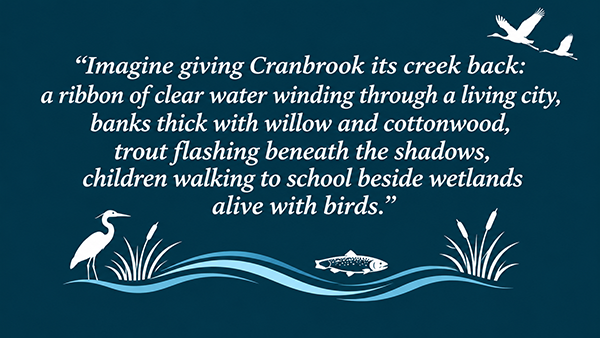
Imagine giving Cranbrook its creek back: a ribbon of clear water winding through a living city, banks thick with willow and cottonwood, trout flashing beneath the shadows, children walking to school beside wetlands alive with birds.
Imagine neighbourhoods shaped by the watershed, where rain nourishes gardens instead of rushing into drains; homes, parks and pathways connected by water; summer shade and places where children learn the names of their living neighbours.
Imagine visitors coming to Cranbrook not to admire what we built over the landscape, but what we brought back to life.
Instead of spending generations paying to overcome the watershed, we could invest in a city that prospers because of it.
Such a transformation would require a new relationship between Cranbrook and the Ktunaxa governments whose rights and jurisdiction are engaged.
Together, they could reimagine housing, infrastructure, public space and economic development around the health of a living watershed.
The Gift of Place
Green describes a Ktunaxa responsibility to all living things, inseparable from Indigenous law, title and jurisdiction.
We inherited an economy that counts what we extract, build and sell, but struggles to recognize what the land already provides.
Colonialism made that arithmetic easier by claiming authority to decide whose land, knowledge and prosperity counted.
Changing the equation means changing who decides, who benefits and who bears responsibility for harm.
As a newcomer living in Ktunaxa ʔamakʔis, I cannot claim its history or authority. I can take responsibility for how I live, what I help restore and whose authority I recognize.
A creek carries water. A forest regulates its flow. A wetland holds a flood. A prairie sustains an economy.
Prosperity begins with what a place already gives. The gift carries an obligation to keep that giving alive for generations.
Chief Isadore knew the prosperity of this prairie. Chief David understood that a homeland could not be given away by someone who did not own it.
Joseph Creek still runs through Cranbrook.
We have learned to make the creek serve the city.
Imagine what Cranbrook could become if, respecting Ktunaxa jurisdiction, we learned to serve the creek.
– Stan Chung, PhD lives on Ktunaxa homelands. He is a writer, speaker, and 2026 Governor General’s laureate.