Home »
24 things that I have learned in local government
By Gerry Taft
Op-Ed Commentary
 Let’s go back in time some 24 years ago. I was a 20-year-old kid, fresh out of a two-year Tourism Management program in Kamloops and newly back home in Invermere.
During those two years away, I had learned two very important things about myself.
- I did not want to work for a big hotel chain and be employee number 498. On a tour of an Earl’s, the frazzled manager was walking us through her gruelling schedule when she gestured at a man across the room, sipping a glass of wine. “Oh, and this is Steve, the owner.” That image said what I had felt in my gut but never put into words. I wanted to be the OWNER, not the manager.
- After two years of breathing pulp mill smelling air, seeing the police cars all of the time, and generally getting a taste of city life- I had figured out maybe Invermere was not so bad after all. I missed it. Every time I came home, I wanted to know what had changed in MY town. At 20, with no money, my best shot at owning and growing a business was in my hometown where people knew me, and I knew it.
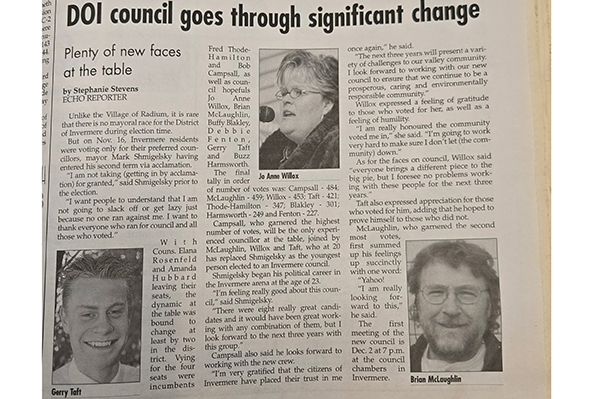
In the fall of 2002, while my high school friends were heading back to university or off traveling the world, I chose to stay in Invermere. As it happened, there were local government elections that fall.
I had been a political nerd from a young age. In Grade 6 I put Reform Party bumper stickers on my bike, and told people that one day I would be prime minister. In high school I was active in student council and British Columbia Youth Parliament.
While I was in college in Kamloops, I had my mom send me The Valley Echo so I could keep current, and I regularly read the council agendas online.
Running for town council at 20 wasn’t that radical for me.
The scariest part of putting my name forward was the three-year commitment (terms were three years back then). This meant committing to staying in Invermere for at least three years- and as a 20-year-old without solid plans and still trying to start the business – that was the hardest decision to make.
What came to mind was one of those “No Fear” shirts: you are either part of the solution or part of the problem. If I was going to stay in Invermere, I wanted to be part of the solution. I wanted to help make the place the best it could be. I did not want to be the bitter guy on the side-lines complaining.
As I scrambled to put together a little election pamphlet, the only photos I could find of myself had me holding a beer. Well, I thought, I am only 20. I might as well own it. So, I put the beer holding photo onto my election flyer. I wish I had kept a copy, or knew where I saved one; sadly I can’t find the flyer to show you.
My mom said I would lose because of the beer photo. It was not really a conscious choice, but deep down I knew people would either accept me for who I was or they would not. I also knew I wasn’t going to pretend to be someone that I wasn’t. Thankfully, the community did accept me.
After two terms on council, at 26, I ran for Mayor and won. I served 10 years as Mayor (and as a Director for the Regional District of East Kootenay, along with sitting on AKBLG and UBCM and other boards).
The biggest shock moving into the Mayor position was how much weight many people hold for that title.
The week before the election, I was a single 26-year-old at the bar – and no one cared. A week after the election, I was still single and again at the bar – and someone came up to me and asked, “What are you doing here?”
I had not changed, but the way people looked at me certainly had.
I tried to move up in politics, and ran for MLA in 2017 – and lost. It was messy nomination process, and at the time I was fighting a defamation lawsuit during the election (which I also lost). My experience with partisan politics was not positive. It was interesting to see the difference between non-partisan local government politics and very partisan provincial politics. And how some of my biggest and most loyal municipal supporters, people I would consider friends, did not vote for me because of party politics.
In 2018 I started a new career in real estate sales. That fall, as the municipal elections were coming closer, I was struggling with what to do. I had every reason to get out of politics at that time, but I still cared a lot and there were things that weren’t finished. And I wasn’t ready to be done.
I could have run for Mayor again, but I knew I would have a serious competitor and it could be a very close election. I also realized I needed to make some money to pay for the lawsuit, and I needed people to think REALTOR when they heard my name, not Mayor. And it would be very hard to be excellent and effective at both at the same time.
I chose harm reduction over quitting cold turkey, asked for a demotion back to councillor, and I have been very happy with that position and that choice for the last eight years.
There have been plenty of highs and lows over the 24 years, but ultimately no regrets about the time and energy spent, about the experiences, about the learnings. Sure, there are a few decisions or positions that I would do differently with the benefit of hindsight, but not too many.
If was about me – I would be happy to keep going. I still care. I still have energy. I am not completely jaded and bitter. My health is good. My kids are older now. I don’t have to quit.
But looking around the council table, I see a great group of people who I have enjoyed working with, who I trust will do a good job. Likely they will all run again this election. Looking forward to the term after, maybe a bunch of them won’t run again, there could be a really big turn over in four years. If I did another four years, maybe I would be really done then.
When I look at what is the best for the community, for the organization- it makes sense to get at least one new person involved and on council this fall so that there is the potential for some continuity and less turnover four years from now.
I also have some strong opinions. I am not sure that systematically local government and the Province of BC has improved over the last 24 years. I hope that I can use some of what I have learned to effect some change from the outside. It feels like a person can be freer, more blunt, and maybe sometimes more effective from the outside.
One of the things that worries me most is how much more complicated and bureaucratic everything has become. Things were always slow, always complicated, and always expensive. But everything is getting exponentially more so, and it’s reaching a potential breaking point.
I know I am going to miss it. There are a lot of people I will miss working with and seeing. But it feels good to go out on a high note, and on my own terms!
And now I get to give advice! If you are thinking of running, if you are already in office, or if you just care about your community and local democracy, here are 24 things I have learned and have come to believe after 24 amazing years of service.
If you are running, hopefully these are useful and give you some things to think about.
If you are voting, hopefully you can use some of these to help decide who to vote for.
- If you are going to put your name forward for elected office, know your ‘Why’, and be honest with yourself about why you are doing it. Rarely is one issue or a narrow focus the right ‘why’. If fame, recognition, and an ego boost are your ‘why’, you will be sadly disappointed by how little of those you actually receive.
- The position has a policy and political element to it, but it also has a ceremonial element to it. Lots of time people want an elected official at an event, or in a parade or on a committee not because of your wisdom- but because of your title. Personally, I hated the ceremonial element, but some people love it. Learn what fits better for you and lean into that. If you love parades- then go to every single one. If you love policy, then dig into policy. You don’t have to love all of it and you don’t have to pour energy and time into everything.
- Your position is to be a two-way conduit of information, moving perspectives in both directions. Sometimes that means carrying concerns and feedback from the public or stakeholders to staff and council. Other times it means explaining the background, nuance, and details of a decision back to the public.
- There is a big difference between complaining and trying to find solutions. Spending too much time on people who only want to complain takes away from solving the actual problems.
- The most engaged and passionate people, the ones who care so deeply about a rezoning or a specific issue (or pickleball), will often stop attending meetings the moment that issue passes. Rarely do people stay engaged unless something impacts them very directly. More often than not, the deep concern is short lived.
- There are plenty of legitimate reasons why most people don’t have the time or energy to stay engaged, and we rarely make it interesting or easy to do so. A small number of vocal, consistent, and engaged people can end up with an outsized level of influence. Remember that issues don’t only affect the people in the room. Remember everyone else too.
- It only takes one unstable, angry, or overly critical council or board member to change the entire mood of a meeting and how safe people feel expressing their opinions. Don’t be that person. And try to help others not become that person.
- The beer test. Never let a discussion, a debate, or a vote get so heated or personal that you couldn’t sit down and have a beer with the other person afterward.
- Your job as an elected official is to ask questions, and sometimes to try to answer them. Don’t be afraid to ask, but take the time to learn when, how, and who to ask. There is a big difference between an ambush or grandstanding and legitimate curiosity and trying to solve a problem. A good test of which kind of question it is: do you really want to know the answer?
- Never blame staff if you weren’t prepared. Own it; and do better next time.
- One of the hardest but most important things to learn is to not be afraid to make a hard decision, and also not to be afraid to seek more information or defer when a decision is being rushed. But never use seeking more information or further study as an avoidance technique. If you already know what the right decision is, make it.
- If there is legitimate new information, an unheard perspective, or a genuine reason to reconsider, then change your mind and do it. But backing down from a tough decision because of public pressure is a slippery slope. Life is hard with no backbone. And bullies will remember it.
- Wait at least 12 hours before sending the terse email or the sharp social media comment. Sometimes they are on point and necessary, but usually a bit of time softens the bite, or removes the need to hit send at all.
- Being an elected official is a lot like jury duty. You are a layperson. You aren’t supposed to be the expert. But you do need an open mind to weigh the evidence and make an informed decision. Your job is not to make a perfect decision. It is to make the best decision you can at the time, with the information available to you.
- A great CAO or senior manager will give sound advice without making their personal or political opinions obvious. Avoid at all costs letting a manager act as an extra, unelected member of council or the board.
- As an elected official you shouldn’t ‘play with the trains.’ But you should know a bit about the train schedule, and if things are going off the rails, you have an obligation to step in and stop a crash.
- A great board or council is a reflective cross section of your community. A monoculture of age, background, or sex is not healthy and tends to create group think.
- We don’t like it when other levels of government make our lives more complicated. Lead by example and look for the places where processes can be simplified. Don’t just add rules and complexity. Don’t be afraid to subtract. A Christmas tree can only hold so many decorations. If you keep adding and adding, eventually it collapses.
- We need to be more firm and effective in pushing other levels of government to do their jobs properly, and to fund local governments properly.
- Hire fewer consultants. Listen to your entry level and on the ground employees more.
- To develop best practices, someone had to try something first. Just because everyone else does it a certain way doesn’t mean it fits your community, or that it is even the best way to do it. We need to take some risks, try new things, and stop being so risk averse. It’s okay to have a local culture and do things your own way. I bet some of the bigger communities could learn a thing or two from the smaller ones.
- Let’s normalize mayors running for council, and past elected officials being available for mentorship and guidance. The corporate and political memory matters, and it also gives people an off ramp and a way to keep contributing. Politics and local government can be an addiction, and not everyone can quit cold turkey. Some of us need the gentle harm reduction approach.
- For rural communities and regional districts, and maybe even medium sized cities, let’s not turn elected governance into a specialized full-time job. Elected officials are not staff. Elected officials are not experts. We need to leave room for regular people of all ages, backgrounds, and employment/income levels to participate. Paying more is not always the answer. Sometimes having fewer meetings is.
- Know when to quit. Do what is right for your community and for succession planning. Often that means not running for one more term, though occasionally it might mean running for one more because you are needed. Think about future councils. Find people to mentor.
Find Gerry’s Substack and more columns here.
Lead image: A clipping from now defunct The Valley Echo after Gerry Taft first won election as a District of Invermere councillor.
Editor’s note: Thanks for those 24 years of service, Gerry. You’ve been an outstanding representative of Invermere and this region. Enjoy the time off and the space!
The municipal and regional election is Oct. 17.