Home »
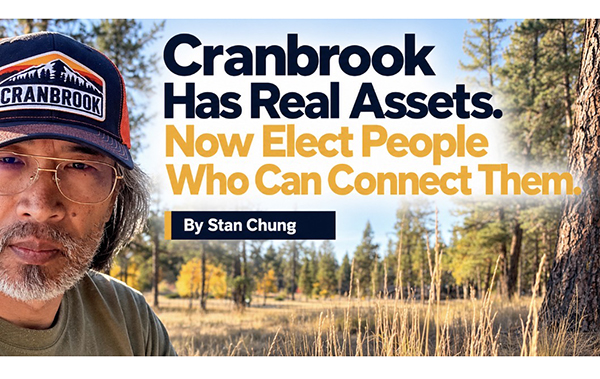
Elect people who can connect Cranbrook’s assets
By Stan Chung
Op-Ed Commentary
What if Cranbrook became known as the small city where young people can build great careers without leaving home?
A young person earns college credits before finishing high school, takes a paid internship with a local manufacturer and helps that company sell products around the world. Their parents can find child-care. Their grandparents can afford to live nearby.
This is no distant dream. Cranbrook already has manufacturers with international customers, Ktunaxa-owned businesses, a regional college, skilled workers and cultural attractions that bring people here.
What we need is a plan to get these strengths working together.
Fixing roads and managing taxes are basic duties. The harder job is building an economy that gives people good reasons to stay.
Read the numbers carefully
Cranbrook’s federally registered businesses grew from 2,191 in 2020 to 2,441 in 2024, an 11.4% increase, before dipping slightly in 2025.
By September 9, 2026, building permits totalled $309.8 million. About 70% went toward hospitals, care facilities and other public buildings.
That is a lot of construction. But are we building an equally strong economy?
A machine shipped overseas, a consulting job in Alberta or a visitor’s hotel bill brings outside money home. Public services also bring jobs and income.
Yet growth means little to a family that cannot afford housing or find child-care.
Council cannot control the economy. It can bring people together, clear roadblocks and make public spending count.
Here are 10 places to start.
- Manufacturing: the world already buys from Cranbrook
Applied Compression Systems has installed more than 800 compression packages worldwide. In 2026, B.C. committed up to $550,000 to expand its Cranbrook operations, with 16 jobs expected over three years.
Kootenay Wood Preservers received up to $450,000 in 2025 to move and modernize production, with nine jobs expected.
Together, that is up to $1 million in public support and 25 possible new jobs.
These companies have products and customers. What do they need to win more orders? Skilled workers? Equipment? Space?
City leaders should meet with them and the college to identify and remove barriers.
Ask our local candidates: “Which manufacturer’s growth problem will you help solve first?”
- Professional services: a small city can serve a big world
VAST Resource Solutions reports more than 55 scientists, engineers, technicians and foresters. Lotic Environmental reports up to 30 full- and part-time staff. Ktunaxa-owned Nupqu works in forestry, archaeology, environmental services and land restoration.
These firms serve clients far beyond Cranbrook, bringing income home while employees raise families here.
A small city can sell its skills to a much bigger world.
Help these firms win larger contracts and connect their hiring needs with local training.
Ask our candidates: “How will you help local firms win outside work and hire local people?”
- Education: build the road from high school to great jobs
A teenager should not have to leave Cranbrook to discover what kind of work is possible.
School District No. 5 offers dual credit, allowing students to earn high-school and college credits together. Its career programs introduce students to trades and workplaces.
College of the Rockies reported about 190 students learning through employer projects in 2024–25, alongside hundreds of placements in health and human services.
In May 2026, the college and KORE Outdoors announced Canada’s first outdoor gear repair and advanced manufacturing centre, backed by $1 million in provincial funding.
Ask SD5 Board candidates to show where this work leads. How many students earn credits, gain workplace experience, receive pay and move into apprenticeships or lasting jobs?
Bring SD5, the college, Ktunaxa governments and employers together to build clear paths from school to work.
Ask all candidates: “How will you turn high-school learning into great local jobs?”
- Transport and trade: find customers first
Our airport recorded more than 176,000 passenger trips in 2025—not 176,000 different tourists.
The city’s $81,000 aerospace study, funded equally with Ottawa, explores business opportunities.
But a runway does not create an aerospace industry. A railway does not guarantee a profitable shipping centre.
Find customers first. What will they buy, how much and at what cost?
The airport could also help visitors book flights, hotels and regional activities together.
Ask candidates: “What proof of customers will you demand before spending more?”
- Tourism and culture: sell the whole weekend
The amazing Key City Theatre sold more than 32,000 tickets in 2024–25, presented over 35 events and hosted more than 150.
Those sales support performers, bring visitors downtown and give our region a place to gather.
As a former BC Arts Council chair, I know public funding matters. Artists also need audiences and paid work.
Why can’t visitors book a weekend with the Baker Hotel, a Key City performance, the Cranbrook History Centre and dinner downtown?
Add cycling, golf, hiking, skiing and Indigenous cultural experiences developed with rights holders.
We have the attractions. How do help make them easy to book together?
Ask every candidate: “Who will organize and sell a complete Cranbrook weekend?”
- Food and drink: a city worth tasting
Family Thai, Sakura Sushi & Grill, Fisher Peak Brewing and The Heid Out, and Fire Hall Kitchen & Tap create jobs and help make downtown lively.
Could more local farms supply our restaurants?
Growers and restaurant owners need reliable delivery, storage, fair prices and steady buyers.
Ask what they need before spending money on another building or program.
Ask all candidates: “What would help local farmers sell more food to Cranbrook restaurants?”
- Child-care: turn a building into opportunity
The planned city child-care centre has $13.5 million in provincial funding and room for 123 children.
Parents need spaces that are staffed, affordable and open when they need them. A nurse starting before dawn has different needs from someone working nine to five.
The operator, college and major employers should plan staffing and hours together. Families deserve clear opening dates and enrolment information.
Good child-care helps parents work, study and earn better wages.
Ask our candidates: “How will you turn 123 planned spaces into 123 usable spaces?”
- Health care: think bigger, but know who pays
Cranbrook wanted a third floor above its approved cancer and kidney-care building. More patients receiving treatment close to home is a worthy goal.
The hospital district committed up to $15 million, depending on another $15 million from Elk Valley Resources. Provincial funding for the extra floor was not secured.
Meanwhile, the original two-storey project’s estimated cost rose from about $59 million to $76.7 million. The hospital district approved another $7.13 million.
Health Minister Bowinn Ma linked some added costs to local decisions. Construction inflation and other factors also played a part. The third-floor proposal did not cause the entire increase.
The East Kootenay Foundation for Health shows what community fundraising can achieve. But generosity cannot replace firm financial agreements.
The lesson is not to think smaller. It is to know who carries the risk before making the commitment.
Please ask our candidates: “What financial protections should have been secured before pursuing the third floor?”

- Energy: we powered a continent. What did we lose?
Before the great dams, the Columbia and Kootenay valleys held rich farmland, Indigenous gathering places and living rivers.
Grand Coulee Dam blocked salmon from the Canadian upper Columbia in 1941. The 1964 Columbia River Treaty brought more flooding. By 1975, about 110,000 hectares of Canadian land and ecosystems had been submerged. More than 2,000 people were displaced. Ktunaxa cultural places disappeared beneath the water.
Electricity flowed south. Downstream communities gained flood protection. The salmon never returned.
Columbia Basin Trust was created in 1995 and has delivered more than $1 billion in regional benefits.
But can grants replace lost farmland, salmon and ancestral places?
For generations, this region gave up land and rivers so others could benefit from our power. We cannot undo that history.
But we can ask: who will own and benefit from the next generation of energy projects?
Why not use solar panels on large rooftops, heat from the ground for public buildings or wasted industrial heat for greenhouses?
Could Ktunaxa governments and local communities own part of these projects, keeping more jobs and savings here?
Bring together Ktunaxa governments, power companies, Columbia Basin Trust and industry. Study the costs and test the best ideas.
Ask candidates: “Will you help create an energy plan that lowers bills and gives local people more control?”
- Seniors and poverty: help before the keys are lost
A senior sits at the kitchen table choosing between groceries, medication and rent.
By the time an eviction notice arrives, help may be too late.
Community Connections Society’s Cranbrook Food Recovery program distributed 201,734 pounds of food in 2025. It supported 34 community groups, schools and events and helped provide 21,512 community-meal servings.
That is remarkable work. It also shows how many people need help.
Community Connections already helps people find housing support and other services. Food programs, rent assistance, tenant advice and seniors’ services should work together to reach people sooner.
We can plan major public buildings. Surely we can help an elderly neighbour before they lose their home.
Please ask candidates: “How will you help seniors stay housed before a crisis?”
Fear can shrink a city’s future
When rent rises and money gets tight, politics gets smaller. We argue over taxes, grants and who deserves help.
These worries are real. But we can spend all our time fighting today’s problems without changing what causes them.
Look at what Cranbrook already has: manufacturers selling worldwide, scientists serving distant customers, schools building career paths, theatres drawing audiences and volunteers helping neighbours survive.
What if these were parts of one city-wide plan instead of separate success stories?
Ask candidates for three priorities. Who will help? What will they do first? How will they pay for it?
We deserve more than promises to work harder or spend less. We need leaders who can help Cranbrook grow while making everyday life better.
The measure of leadership is not how much a city is doing. It is whether what it does is changing what matters.
Cranbrook resident Stan Chung, PhD is a writer, speaker, strategic advisor and 2026 Governor General’s laureate.