Home »
Invasive of the Month
By East Kootenay Invasive Species Council
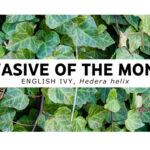
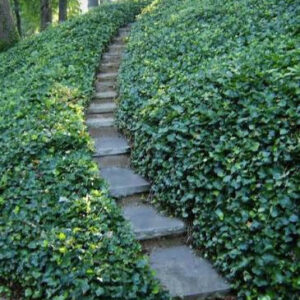
English ivy (European ivy, Common ivy) was commonly planted to provide quick cover for walls and buildings, and as ground cover in commercial landscapes. It was intentionally introduced from its native range of Europe.
It has since spread throughout rainforest understories where it can grow as a dense mat that suppresses native plants or climbing up trees, reducing their lifespan and leaving them more susceptible to wind damage.
English ivy grows rapidly and needs very little light or water once it has established and even grows during the winter. It reproduces through seed and vegetatively and its berries are preferred and spread by birds.
 IDENTIFICATION:
English ivy is an evergreen vine that will be found growing as dense groundcover or climbing up trees.
Clusters of small white to yellow-green flowers bloom in late summer and early fall and are followed by clusters of black shiny fruit.
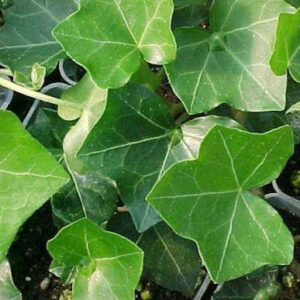
Leaves are star-shaped with threet o five points, waxy and leathery. Leaves on the fruiting stems will be egg-shaped without points or lobes.
Both sets of leaves can range from five to 10 cm long and six to 12 cm wide and can be a range of different colors: dark green, silver-green, yellow, white.
IMPACT:
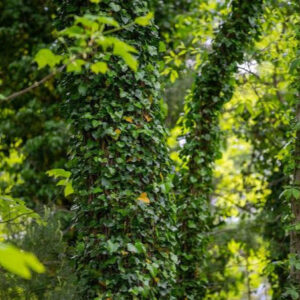 Ecological: English ivy can form dense monocultures that spread on the ground and on other plants and trees. It can suppress and exclude native vegetation by smothering them and competing for light.
The excessive weight of English ivy growing on native plants can leave them more vulnerable to blowdown and disease.
English ivy can also create unsuitable wildlife habitat and forage availability. It can serve as a vector of Bacterial Leaf Scorch, a plant pathogen that is harmful to maples, oaks, elms, and other native plants.
Economic: Has the ability to damage infrastructure it grows on.
Health impacts: Has been found toxic to humans when eaten and may cause dermatitis in sensitive individuals.
 MANAGEMENT:
Mechanical control: Hand-pulling and cutting can be effective in late summer or fall. Cut climbing vines and pull rooted portions to prevent regrowth. For vines growing up trees, cut the vines at a comfortable height and remove the rooted portions from the ground. Multiple treatments may be needed. Wear gloves and long sleeves, as English ivy can cause skin irritation. Bag and dispose of removed plant material in the garbage/landfill. Do not compost, as cuttings can re-root.
Biocontrol: There are currently no biological control agents available for English ivy.
Chemical control: Herbicide use should be based on site conditions, management goals, and current product labels. Herbicide treatments may be used in combination with mechanical control and often require repeat applications. On Crown land in B.C., pesticide use must follow an approved Pest Management Plan and be carried out by a certified pesticide applicator.
 East Kootenay Invasive Species Council photos
The East Kootenay Invasive Species Council works to minimize the threat of invasive species that impact the environment, the economy and human health in the East Kootenay region of B.C., and we couldn’t do it without you! as a non-profit, we rely on grant funding and the generous support of our community to operate. Your donation will help us continue to protect the East Kootenay from invasive species. Donate here.