Home »
Summer rush increases risk for roadside workers
Drivers urged to slow down, leave phones alone, and follow directions
The July 1 holiday kicks off summer vacation season, when many drivers feel the pressure of getting to their destinations while juggling thoughts of schedules, ferry reservations, campsite check-ins, and fuel stops.
Those added stresses can increase the risk for roadside workers, who do their jobs just metres from fast-moving vehicles. It also increases the risk to drivers and their passengers. ICBC statistics show that July has the second highest number of crashes, behind only December. Over the past five years, July has averaged just over 26,000 reported crashes.
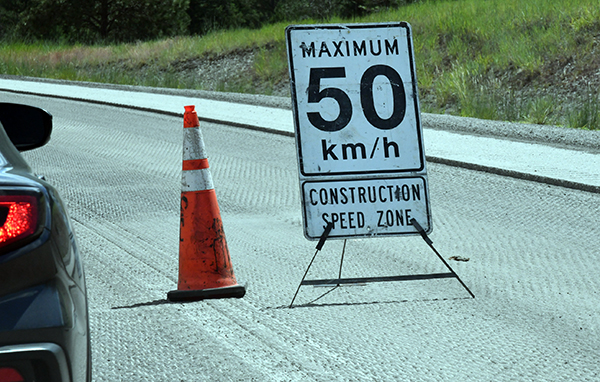
Hot weather and glare can increase driver fatigue, while distractions inside and outside the vehicle can make drivers less likely to notice signs, cones, or stopped vehicles. It’s a dangerous combination in work zones, where there is little margin for driver error.
“Work zones are complex, fast-changing environments. If drivers lose focus even for a moment, they can miss critical cues,” said Trace Acres, spokesperson for the annual Work Zone Safety campaign managed by Road Safety at Work. “And that’s when people get hurt.”
From 2016 to 2025, 11 roadside workers were killed and 263 more sustained injuries resulting in time loss claims, according to WorkSafeBC statistics.
Reducing speed, ignoring phones and other distractions, and following signage and other instructions can help keep people safe.
Work zones are a daily reality for many drivers and a high-risk environment for the tens of thousands of roadside workers in B.C. These include traffic control persons, road construction and maintenance crews, tow operators, utility crews, emergency responders, landscapers, and others.
While in their work spaces, drivers need to actively scan for changing traffic patterns and uneven surfaces, as well as for people working, walking, or cycling. “You need to be ready to respond at any moment,” Acres said.
“If you’re distracted, speeding or not paying attention to flag persons and signage, you may not have enough time to react safely. “A moment of inattention can have life-changing consequences.”
Law requires drivers to slow down, avoid distractions, follow directions
The safest thing to do is avoid work zones when possible by checking traffic reports and adjusting routes.
In you have to drive through a work zone, B.C. law requires you to:
Slow down and obey posted speed limits;
Stay alert and avoid distractions, including phones and in-vehicle technology;
Obey traffic control persons and devices.
When approaching a vehicle with flashing lights at the side of the road, drivers must also follow the Slow Down, Move Over law. The law requires drivers to reduce speed and, when safe, move over into the next lane. Drivers must slow to 70 km/h in zones where the limit is 80 km/h or more, or 40 km/h in lower-speed zones.
Driving offences can result in fines of up to $368 and penalty points.
While drivers play a key role in work zone safety, employers are responsible for protecting roadside workers by identifying hazards and assessing risks, ensuring that a traffic control plan is developed based on the risk assessment, and ensuring workers are appropriately supervised and trained to work around traffic.
“Roadside workers are doing jobs that keep our road system running,” Acres said. “Staying alert when you drive through a work zone is one of the simplest ways to help them get home safely.”
Road Safety at Work provides tips for drivers.
The Work Zone Safety campaign is supported by the Road Safety at Work Alliance, a group of public and private sector organizations committed to improving the safety of people who drive for work or work at the roadside.
Road Safety at Work is a WorkSafeBC injury reduction initiative managed by the Justice Institute of B.C. It works with employers and workers to prevent work-related motor vehicle incidents, injuries, and fatalities.
e-KNOW file photo