Home »
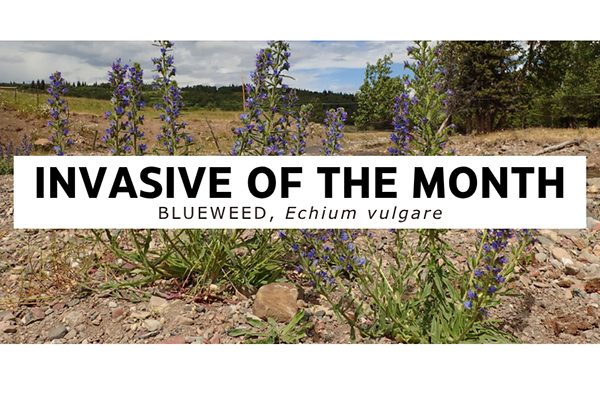
Invasive of the Month
By East Kootenay Invasive Species Council
Blueweed (Viper’s bugloss) is a hairy, painful to touch plant native to Europe, Western and Central Asia. Plants can drop up to 2800 rough seeds that can be further spread by clinging onto animals or humans.
It can be found in dry, basic soils in grasslands, or alongside roads and railways.
It is toxic to horses and cattle and reduces forage quality in rangelands and pastures, resulting in economic losses. Blueweed is designated as a Regional Noxious Weed by the BC Weed Control Act, as well as a Regional Containment/Control species by the BC Provincial Priority Invasive Species List.
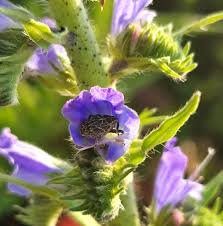 IDENTIFICATION:
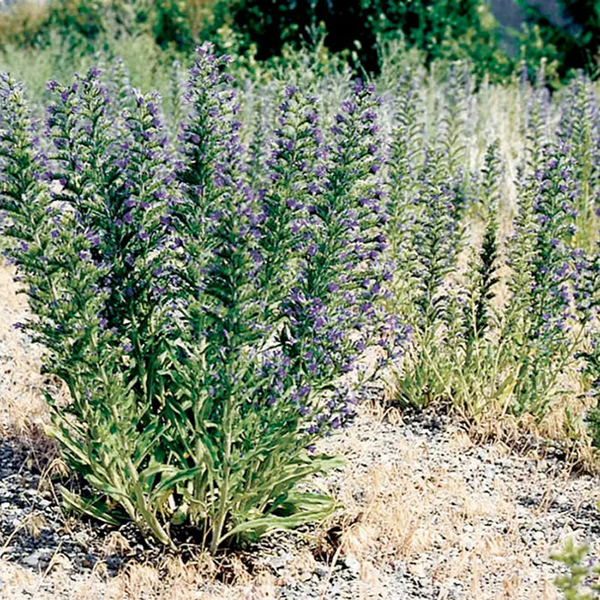
Flowers: Bright blue; five-lobed; found on upper side of short stems.
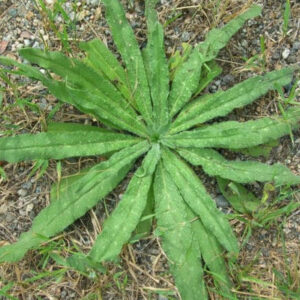
Stems: Hairy, hairs painful to touch; mostly short hairs but some longer hairs are present which have dark, swollen bases producing noticeable flecks; at flowering, 30-80 cm tall.
Leaves: Covered in short hairs; become smaller approaching top of plant.
Fruits: Seeds (called nutlets) appear in groups of four along the stems; each nutlet is approximately three mm long, grayish-brown, rough and wrinkled.
 IMPACT:
Economic: Blueweed reduces pasture productivity by displacing desirable forage and is largely unpalatable to livestock, lowering grazing capacity. Managing infestations requires time, labour, and control costs, and large quantities can pose a risk to livestock health.
Environmental: Blueweed forms dense stands that outcompete native plants, reducing biodiversity and altering ecosystems. It spreads quickly in disturbed soils along roadsides, trails, and overgrazed areas, affecting pollinators and soil health.
Social: Infestations can limit the use and enjoyment of natural areas. Its bright flowers may lead to unintentional spread by the public, and effective management often requires coordinated efforts and public awareness.
 MANAGEMENT:
Mechanical control: Hand-pulling may be an effective control for small infestations; while cutting larger infestations will decrease seed production. Due to the ability to re-sprout, multiple treatments will likely be required to deplete root reserves to the point where flowering and seed production are improbable.
Chemical Control: Herbicide use should consider site characteristics and management goals, and labels must be reviewed before application. Fall foliar treatments with 2,4-D are more effective than spring, while glyphosate works in non-vegetated areas but should avoid desirable vegetation. Combinations like metulfuron-methyl plus aminopyralid, or picloram with 2,4-D, provide longer-term control. Surfactants can improve effectiveness, and clopyralid is recommended near conifers. Monitor results over multiple years, and Crown land applications must follow a Pest Management Plan by a certified applicator.
 East Kootenay Invasive Species Council photos
The East Kootenay Invasive Species Council works to minimize the threat of invasive species that impact the environment, the economy and human health in the East Kootenay region of B.C., and we couldn’t do it without you! as a non-profit, we rely on grant funding and the generous support of our community to operate. Your donation will help us continue to protect the East Kootenay from invasive species. Donate here.