Home »
Kootenay Connect Priority Places
Seven years and $12.6 million invested
Seven years, dozens of local organizations and specialists, and countless species helped — Kootenay Connect Priority Places has achieved ambitious conservation across the region.
Managed by Kootenay Conservation Program (KCP), the initiative included over 60 projects designed to protect species at risk in priority landscapes across the Kootenays.
“Since 2019, Kootenay Connect Priority Places supported over 60 projects ranging from inventorying and mapping species at risk and sensitive ecosystems, to restoring floodplain and grassland habitats, to installing specialized habitat features such as basking logs for turtles and tree roosts for bats,” said Marcy Mahr, KCP Kootenay Connect Manager.
“This initiative is an amazing example of how leading-edge science and local knowledge can be applied on the ground with lasting benefits. It’s a Kootenay-made solution to our global biodiversity crisis,” she added.
With $4.2 million in funding from Environment and Climate Change Canada, the initiative leveraged an additional $ 8.4 million through matching contributions from local sources including the Columbia Basin Trust, the Columbia Valley and Regional District of Central Kootenay Local Conservation Funds, as well as in-kind support. Funding was invested into seven priority areas vital to regional ecological connectivity and climate resilience.
“We call it ‘Kootenay Connect’ because conserving biodiversity, protecting species at risk, and maintaining healthy ecosystems requires connecting existing important habitats and protected areas with ecological corridors,” explained Michael Proctor, grizzly bear biologist and Science Advisor for Kootenay Connect Priority Places.
“Collaboration and knowledge-sharing between leading partner organizations and biologists have shown how important these decades-long relationships are in addressing wildlife and conservation challenges together.”
One of the seven priority areas was the Columbia Wetlands, with projects led by Columbia Wetlands Stewardship Partners (CWSP) to research the shifting hydrologic patterns of floodplain wetlands associated with the Columbia River and Columbia Wetlands Wildlife Management Areas (WMAs).
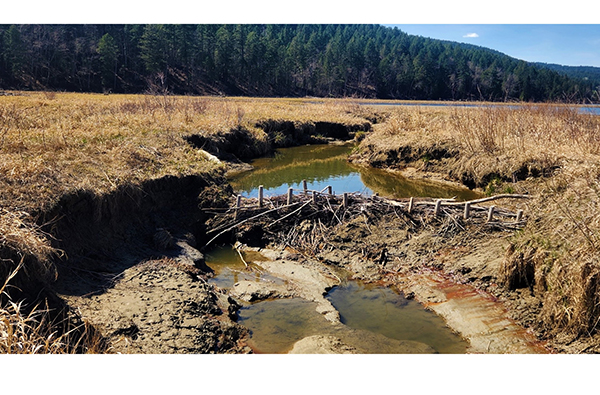
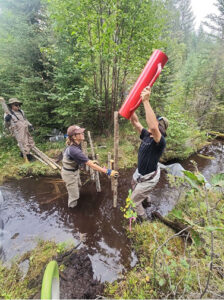
Biologists assessed wetland vulnerability to drought caused by climate change and began building artificial beaver dams (aka beaver dam analogues) as a nature-based solution to maintain water on the landscape – both in the valley bottom floodplain and the west side benchlands. Between 2024 and 2025, CWSP constructed 25 beaver dam analogues, retaining roughly 54,362 m³ of water to mitigate against drought, and enhancing over 35 hectares of wetland habitat.
“These inspiring projects demonstrate how partners working together, guided by a common regional framework, can have a significant collective impact on the ground,” said Juliet Craig, KCP Program Director.
“Kootenay Conservation Program, a regional partnership established in 2002, has cultivated decades of trust and collaboration, laying the groundwork for this remarkable initiative.”
Lead image: An example of a beaver dam analogue in the Columbia Wetlands built to retain water and restore wetland habitat. Catriona Leven/CWSP photo
Kootenay Conservation Program